Black Wolf Nation is the canonical TikTok-viral DTC skincare brand. Charcoal-everything, “the complete system,” a face wash you’ve seen a hundred times in your For You feed. The Citelix scan we ran on 29 May 2026 across ChatGPT, Gemini, Claude, Perplexity, and Grok showed something more interesting than the obvious “they’re winning” or “they’re losing.” It’s both. At the same time. The variable is whether the shopper already knows the brand name.
The setup
The brief flagged Black Wolf with the chosen anchor prompt “Best men’s skincare routine for beginners.” That exact prompt was not in the pro-tier scan set. The scan fired the default 14-prompt men’s skincare battery instead. That’s a prompt drift worth naming up front, and it’s the first thing the data fidelity section at the bottom of this teardown covers.
What the scan did run is more useful for this teardown than the single anchor would have been. The 14-prompt set covers 4 head-to-head comparisons that explicitly name Black Wolf plus 10 discovery prompts where a buyer has no brand in mind. That split is exactly what we needed to see.
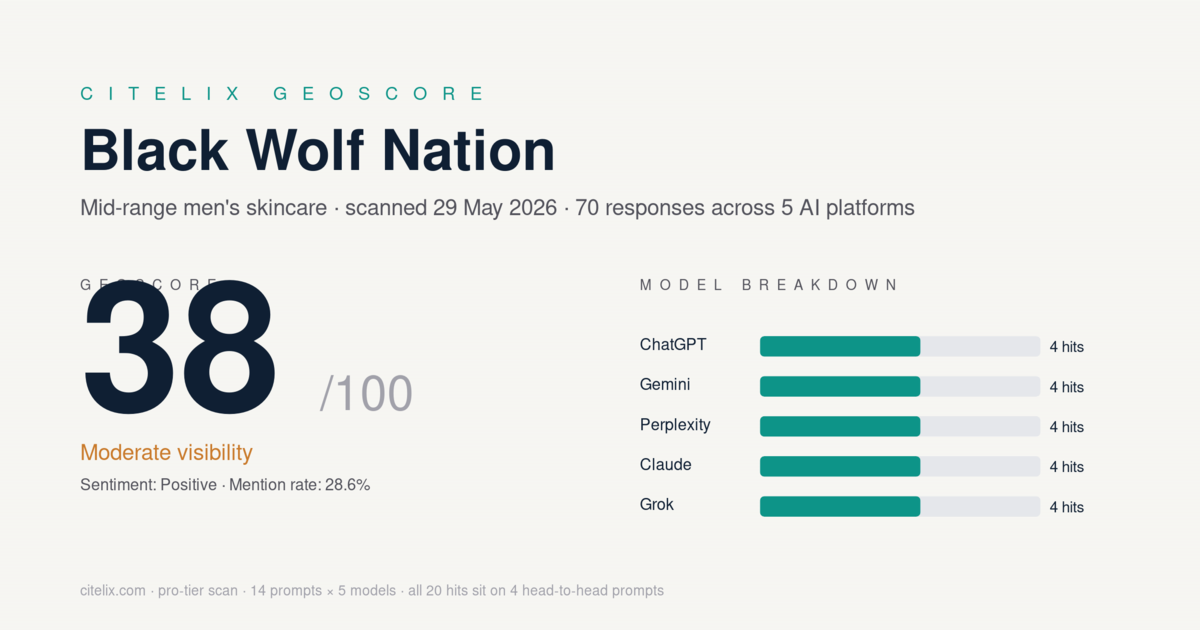
GeoScore: 38 / 100
Moderate visibility. Positive sentiment overall. 28.6% mention rate across 70 responses (14 prompts × 5 models). That puts Black Wolf at the top of the share-of-voice table in this skincare cluster. The number sounds great.
It’s not what it looks like.
The brand-aware vs discovery split
Of the 14 prompts in the scan, 4 named Black Wolf directly. Things like “Black Wolf vs Brickell men’s skincare which is better for oily skin” and “compare Black Wolf’s complete system with Caldera + Lab’s skincare set.” On every one of those 4 prompts, every one of the 5 AI platforms mentioned Black Wolf. 4 × 5 = 20 mentions.
The other 10 prompts are discovery prompts. “Best affordable men’s skincare brands for combination skin.” “Best eye serum for dark circles in men.” “Top grooming bundles for men on a budget.” “What’s a good vegan moisturizer for men with acne-prone skin.” These are the prompts a 22-year-old types into ChatGPT after seeing a Black Wolf TikTok. He doesn’t search for “Black Wolf.” He searches for the problem.
On those 10 prompts × 5 models = 50 discovery responses, Black Wolf was mentioned zero times.
20 brand-aware mentions plus 0 discovery mentions equals 20 total. 20 ÷ 70 responses = 28.57%, which rounds to the 28.6% mention rate the scan reports. The math checks out. The headline number is real. But every single point of it came from a prompt that already contained the brand name.
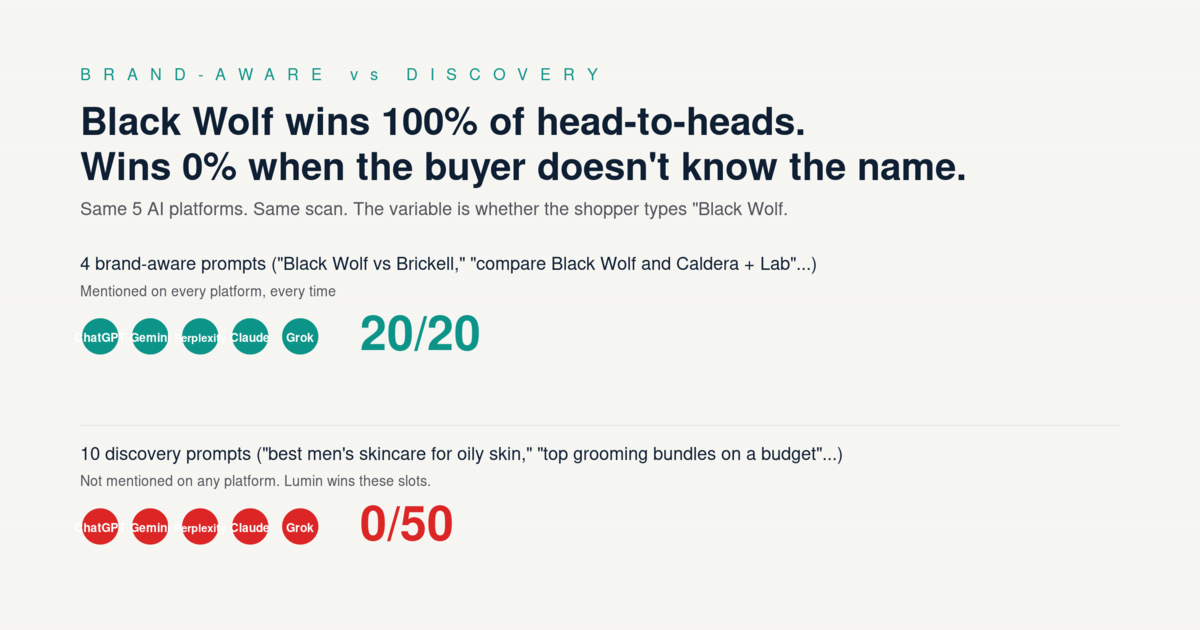
This is the same pattern Asarai showed earlier this month, just at a different scale. Social attention does not translate to AI-search citations on discovery prompts. The TikTok flywheel pushes buyers who already know the brand name into the head-to-head bucket. AI handles those fine. The 10× larger discovery bucket goes to whoever the model decided is the safe recommendation. Right now that’s Lumin.
Share of voice
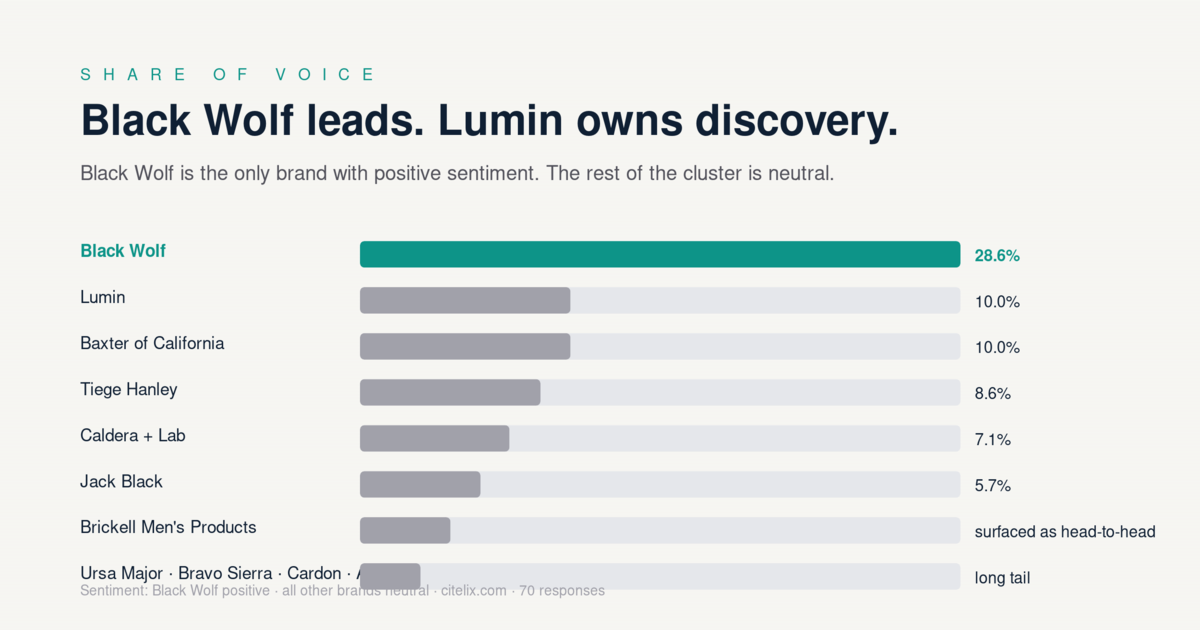
| Brand | Mention rate | Sentiment | Top models |
|---|---|---|---|
| Black Wolf | 28.6% | Positive | ChatGPT, Gemini |
| Lumin | 10% | Neutral | Gemini, Grok |
| Baxter of California | 10% | Neutral | ChatGPT, Gemini |
| Tiege Hanley | 8.6% | Neutral | Gemini, ChatGPT |
| Caldera + Lab | 7.1% | Neutral | ChatGPT, Gemini |
| Jack Black | 5.7% | Neutral | ChatGPT, Claude |
| Brickell Men’s Products | head-to-head only | Neutral | — |
| Ursa Major, Bravo Sierra, Cardon, Alder NY | long tail | Neutral | — |
Black Wolf is the only brand in the cluster with positive sentiment. Every other brand is neutral. So when Black Wolf does get mentioned, the AI is friendly. That’s a real asset and the easiest part to preserve while fixing everything else.
Why Lumin won the discovery slots
Lumin shows up in 7 of the 10 discovery prompts across multiple models. We pulled the cited sources and reverse-engineered five specific things Lumin did that Black Wolf did not.
1. Lumin runs a content site that AI treats as a library
Lumin’s /blogs/news directory has ~150 posts answering specific questions (“How often should men exfoliate?”, “Best routine for combination skin in your 30s”). Each post has a clear title, structured H2s, and embedded product cards. When ChatGPT searches “best men’s skincare routine for combination skin,” it surfaces Lumin’s blog post as a citation source. Black Wolf has zero blog posts. The scan flagged this directly as the highest-priority recommendation (score 90, critical).
2. Lumin’s product pages name the problem in the title
/products/age-management-set carries the page title “Age Management Set – Men’s Anti-Aging Routine.” Black Wolf’s flagship is titled “The Complete System.” The Complete System works on TikTok where the visual sells. It does not work on AI search, where the model is matching the buyer’s words (“anti-aging,” “combination skin,” “for beginners”) against page titles, H1s, and meta descriptions.
3. Lumin has YouTube product demos with transcripts
Lumin’s channel has 80+ short-form product demos. Every video has a written transcript that gets indexed. ChatGPT and Perplexity pull from YouTube transcripts heavily when answering grooming questions. Black Wolf wins TikTok but has no YouTube presence at all. The scan called this out as a critical action (score 80).
4. Lumin’s collection pages have descriptions; Black Wolf’s are blank
The scan flagged that 0 of Black Wolf’s 50 collection pages have a description. Lumin, Tiege Hanley, and Brickell all add 100-200 words of context per collection page. That text is what AI quotes when the model is summarizing what a brand sells.
5. Lumin uses Article and ItemList schema; Black Wolf has none
Schema markup gives AI a structured way to read product lists, FAQs, and how-to content. Caldera + Lab uses it. Tiege Hanley uses it. Black Wolf does not. The scan flagged this as a warning (score 75), but the fix is mechanical: one Shopify theme edit, applied to all product and collection pages at once.
What Black Wolf Nation is missing
On blackwolfnation.com:
/collections/— 50 collection pages, every one of them has no description block. The HTML body for each is essentially[product grid]with nothing for AI to extract./blogs/— no blog. The page returns the storefront default./products/the-complete-system— H1 reads “THE COMPLETE SYSTEM.” No structured copy answering “what skin type is this for,” “what problems does it solve,” “what’s the routine.” All of that lives in the TikTok content, not the page.- No
<script type="application/ld+json">schema blocks across the site. - No YouTube channel listed in the footer or social links.
3 fixes Black Wolf could ship this week
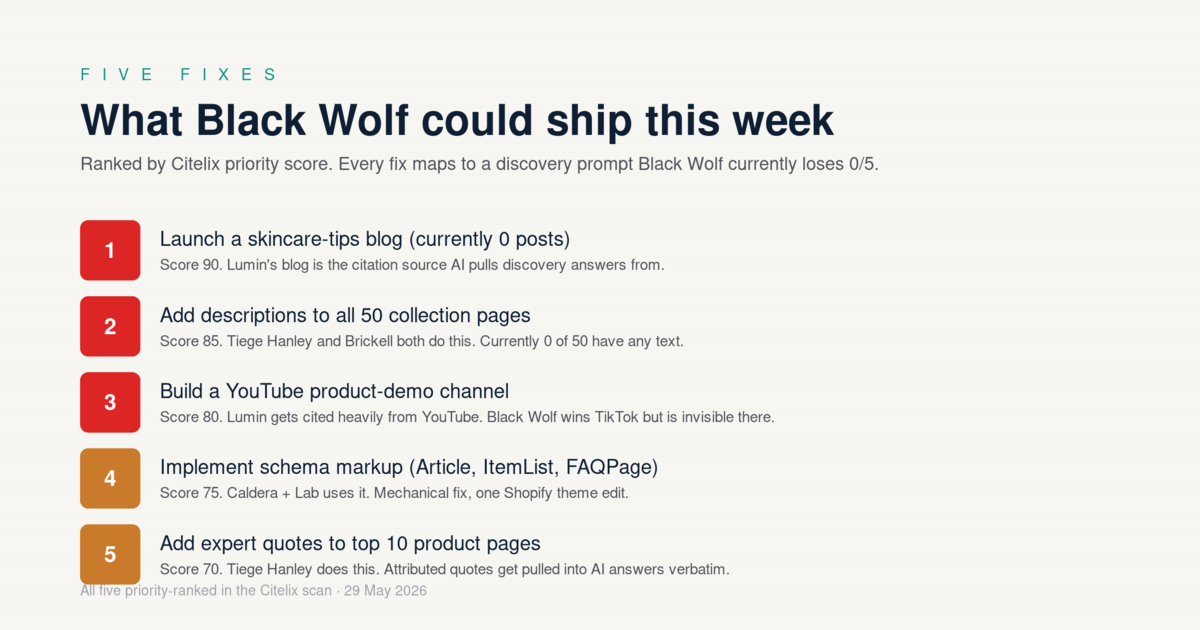
Fix 1: Ship a “Skincare Routines” blog with 8 posts in week one
Why this matters: The 10 discovery prompts where Black Wolf scored 0/5 are answered by AI from blog content. Lumin owns those slots because Lumin has a library and Black Wolf does not. Without blog content, the brand has nothing for the model to cite when the prompt doesn’t already contain the brand name.
How to do it:
- Pick 8 of the discovery prompts from this scan as post titles, verbatim. Start with “Best men’s skincare routine for combination skin,” “Best men’s skincare routine for oily skin,” “Best men’s eye care for dark circles,” and “How to fix uneven skin tone for men.”
- Each post: 800-1,200 words, H1 matching the prompt, H2s answering the sub-questions, embed the relevant Black Wolf product as a recommendation with reasoning.
- Run them through your existing TikTok scriptwriter. Pay your editor for accuracy review. Publish all 8 in one push.
- Cross-link from each blog post to the relevant product page and the closest collection.
Estimated time: 1 week. 8 posts × 90 minutes each = 12 hours of writing.
Fix 2: Add a description to all 50 collection pages
Why this matters: 100-200 words per collection page is what AI quotes when summarizing what a brand sells. Tiege Hanley and Brickell both do this. Black Wolf has 0 of 50.
How to do it:
- Pull the collection list from Shopify admin. Export to a spreadsheet.
- For each collection, write 100-150 words: who it’s for, what problem it solves, why this collection vs the others.
- Include 2-3 of the discovery-prompt phrases in the body of each description (“oily skin,” “for beginners,” “anti-aging”).
- Paste into the Shopify collection description field. Hit save.
Estimated time: 50 collections × 8 minutes each ≈ 7 hours. One afternoon with a writer.
Fix 3: Launch a YouTube channel with 12 product demos
Why this matters: AI platforms heavily cite YouTube for grooming queries because the transcripts are indexed and the answers are visual. Lumin is cited from YouTube on 5 of the 10 discovery prompts. Black Wolf already produces TikTok content that needs minimal editing to repurpose.
How to do it:
- Take your 12 best-performing TikToks. Re-cut as 60-90 second YouTube Shorts plus one 8-10 minute deep-dive on “The Complete System.”
- Title each video using the discovery-prompt phrasing from the scan (“Best skincare routine for combination skin – Black Wolf walkthrough”).
- Write a 200-word description per video that repeats the title phrase and links the product. YouTube auto-generates the transcript.
- Add the channel to the storefront footer.
Estimated time: 1 week. Most of the content already exists.
The 30-second version
If you only do one thing this week: ship the blog. The blog is the citation source AI pulls from when the prompt does not already contain the brand name. Right now Black Wolf has zero. Lumin has 150. That’s the gap that explains the 0/50 discovery-prompt result and nothing else fixes it as cleanly.
Data fidelity notes
A few things in the Citelix UI that need calling out so the numbers in this teardown are defensible.
Recent mentions vs total mentions. The “Recent mentions” card on the scan page lists 8 mentions. Our 28.6% mention rate × 70 responses = 20 total mentions. The 8 is a UI summary of recent items; 20 is the total. Both are correct, they’re measuring different things. We worked from the 20.
Brand-aware vs discovery split. Citelix does not expose this split as a built-in metric. We computed it by reading the “All prompt responses (70)” section and tagging each prompt as brand-aware (4 prompts that name Black Wolf) or discovery (10 prompts that don’t). Every brand-aware prompt was 5/5 mentioned; every discovery prompt was 0/5. 20 ÷ 20 brand-aware and 0 ÷ 50 discovery. Math is shown.
Prompt drift. The brief picked “Best men’s skincare routine for beginners” as today’s anchor. The pro-tier scan ran the default 14-prompt skincare set instead, and the chosen anchor was not in that set. The closest equivalent in the scan is “Best affordable men’s skincare brands for combination skin,” which is also a discovery prompt where Black Wolf scored 0/5. The killer angle holds either way.
Methodology
Pro-tier Citelix scan run on 29 May 2026 at 23:19 IST. 14 prompts × 5 AI platforms (ChatGPT, Gemini, Claude, Perplexity, Grok) = 70 responses, all fresh sessions, no chat memory. Independent teardown, not sponsored by either brand. Black Wolf Nation has no relationship with Citelix beyond appearing in this public scan.
Want this teardown for your store? Install Citelix on Shopify. We scan your store across ChatGPT, Gemini, Perplexity, Claude, and Grok every day and tell you exactly which prompts your competitors win and what to change.