Bloom Nutrition’s whole pitch is that supplements should taste good. Flavored greens powder, Supergreens Gummies, energy sticks, creatine gummies. Its Greens product page carries a 4.4 rating from 15,423 reviews, and its gummies page calls Bloom “the #1 greens powder in the USA.”
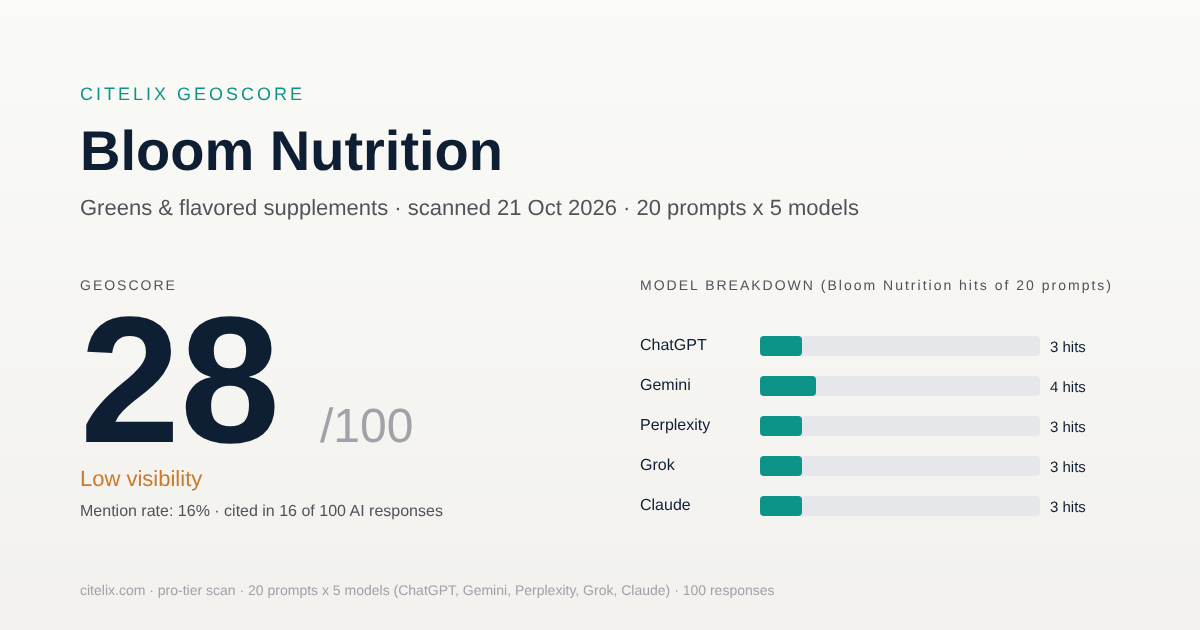
So I expected Bloom to own the taste question when I scanned it across ChatGPT, Gemini, Perplexity, Grok, and Claude this week. It did not. Bloom’s Citelix GeoScore came back at 28 out of 100, cited in 16 of 100 AI responses. And when a buyer asked for the best flavored vitamins for women who dislike pills, all five models answered and none of them named Bloom.
The prompt I tested
The scan ran 20 women’s wellness prompts. The anchor for this teardown:
“best flavored vitamins for women who dislike pills”
Why this prompt: this buyer has already told you the one thing Bloom is built for. She wants her nutrition to taste good and she does not want to swallow a capsule. Bloom sells powders and gummies to exactly this person, and its own Greens page describes the product as “made for women.” If Bloom cannot show up here, its positioning is not reaching the models.
What ChatGPT said
ChatGPT did not mention Bloom. It led with OLLY:
These gummies are popular for their tasty flavors and effective formula designed specifically for women’s health needs.
Then SmartyPants Women’s Formula Gummies, plus Garden of Life, MaryRuth’s, and Vitafusion further down.
The other models agreed almost word for word:
- Gemini led with OLLY Women’s Multivitamin Gummies, “18 essential nutrients plus biotin for hair, skin, and nails,” then One A Day, and named MaryRuth’s too.
- Perplexity opened by saying “the best choices are gummy, liquid, or powder-based vitamins,” then listed Nature’s Way Alive!, SmartyPants, OLLY, and MaryRuth’s liquid. Powder is Bloom’s core format. Still no Bloom.
- Grok led with OLLY, noting its pectin base and “no artificial colors or flavors.”
- Claude listed Nutricost, SmartyPants, OLLY (“Blissful Berry”), Nature Made, and two MaryRuth’s liquids, citing fortune.com, healthline.com, and innerbody.com.
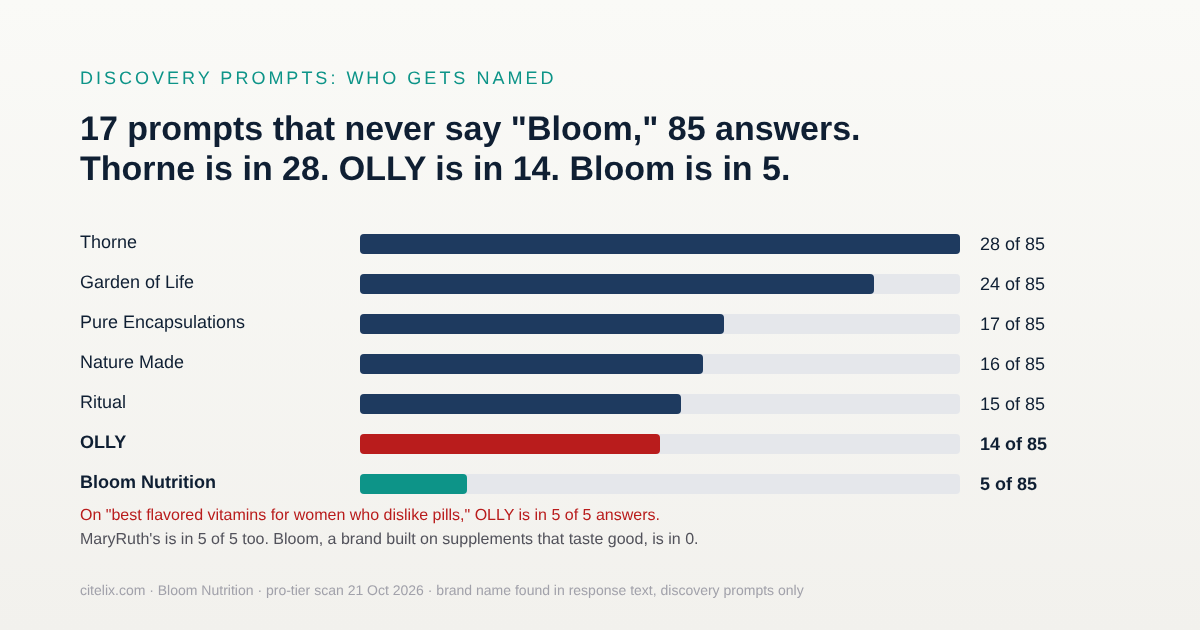
OLLY and MaryRuth’s were each named in 5 of 5 answers. SmartyPants in 4. Bloom in 0.
The discovery gap
The pattern holds across the whole scan.
- Brand-aware prompts (3 prompts that name Bloom, such as “Bloom Nutrition vs Arrae” or “which is better for overall wellness Bloom Nutrition or Ora Organic”): Bloom cited in 15 of 15 responses.
- Discovery prompts (17 prompts that do not name Bloom): the name “Bloom” appears in 5 of 85 responses, about 6%.
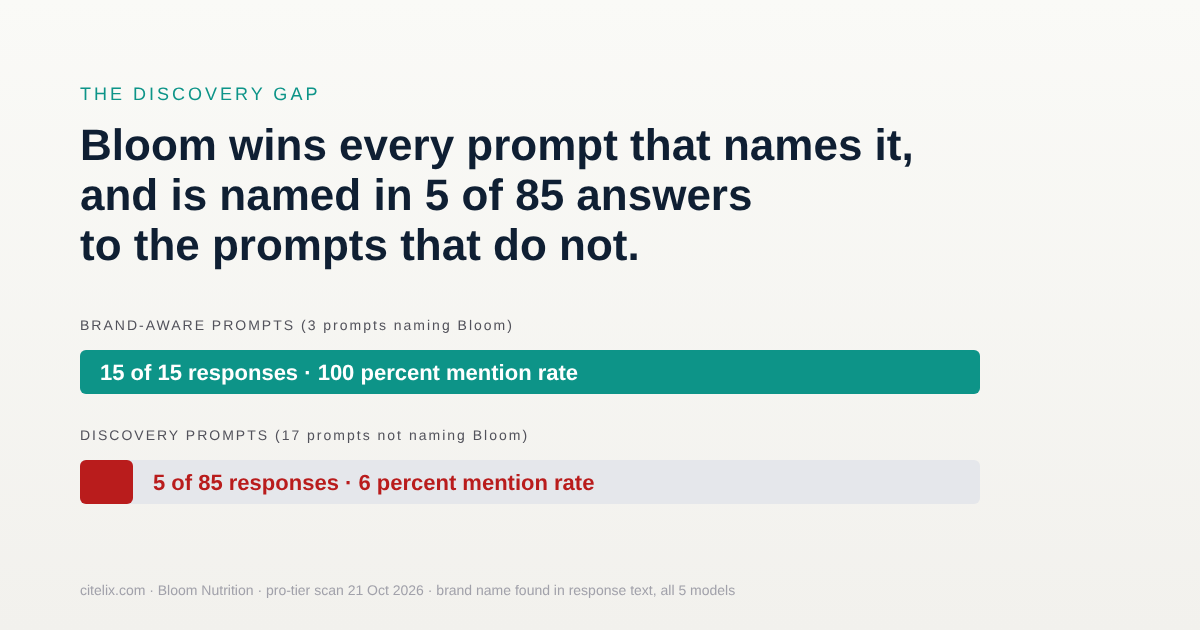
Those 5 mentions all came from three prompts that name Bloom’s own products (“Supergreens Gummies,” “Greens Stick Packs”) without naming the brand. Even there Bloom mostly gets a passing line. On “are greens supplements like the Greens Stick Packs good for immunity,” AG1 and Amazing Grass were each named in 4 of 5 answers. Bloom was named in 2: once as a bullet telling buyers to check the label, and once in parentheses next to Athletic Greens. The scan’s own flag, which only counts a real recommendation, credited Bloom in 1 of 85 discovery answers.
Why OLLY won the flavored-vitamins prompt
I read all five answers, the sources they cited, and Bloom’s own pages. Four things put OLLY ahead.
1. OLLY is filed under “vitamins,” Bloom is filed under “greens”
Every model read “vitamins” as multivitamins and answered with gummy and liquid multis. OLLY sells a women’s multivitamin gummy with a clear nutrient count the models can quote. Bloom does not sell a multivitamin, and nothing on its site tells a model that its gummies and powders are for the person who hates pills. The models do not make that leap on their own.
2. Bloom never uses the buyer’s words
On Bloom’s Supergreens Gummies page, the words “pill” and “swallow” do not appear once. The page FAQ asks “What are the benefits of greens in gummy form?” and “Don’t have time to drink your greens?”, which is the right instinct, but it frames the gummy as an alternative to a greens drink, not to a capsule. The buyer in this prompt is running from pills, and Bloom’s copy never meets her there.
3. The roundups the models read are about multivitamins
Across all 100 responses, the most-cited domains were healthline.com (10 citations), fortune.com (8), verywellhealth.com (7), womenshealthmag.com (7), and everydayhealth.com (6). Claude’s answer to this prompt cited fortune.com, healthline.com, and innerbody.com. These are the “best gummy vitamins” and “best multivitamins for women” lists, and OLLY, SmartyPants, and Nature Made live in them.
4. OLLY shows up across the open questions
Across the 17 discovery prompts and 85 answers, OLLY was named in 14 and Bloom in 5. Thorne (28), Garden of Life (24), Pure Encapsulations (17), Nature Made (16), and Ritual (15) were all ahead too. In the scan’s tracked-competitor table, Ritual had the highest mention rate at 18%, then OLLY at 14%.
What Bloom is missing
I checked bloomnu.com by hand. Here is what stands out for this prompt:
- The product descriptions are one or two sentences. The Shopify description for Greens & Superfoods is 28 words. Supergreens Gummies is 29. The page templates add ingredient blocks and a short FAQ, but the core description a crawler or shopping feed reads is a tagline.
- The schema is in good shape. Credit where due: both the Greens and Supergreens Gummies pages carry ProductGroup schema with the brand set to Bloom Nutrition and an aggregateRating (4.4 from 15,423 reviews on Greens, 4.9 from 104 on the gummies).
- There is almost no editorial content. The sitemap lists 4 blogs and 5 articles in total. None answers a buying question like “what can I take instead of a multivitamin pill?”
- The FAQ page is about orders. /pages/faq covers shipping, discount codes, returns, where to buy in-store, pregnancy, kids, and third-party testing. It has no FAQPage schema, and none of the questions mentions taste, format, or pills.
- The collections are blank. All 79 collections in /collections.json have empty descriptions.
3 fixes Bloom could ship this week
None of these need a new product.
Fix 1: Say “no pills” on the gummies and greens pages
Why this matters: the buyer is describing Bloom’s product in her own words, and Bloom’s pages never use them. Models match the question to text they can quote.
How to do it: Add a line near the top of the Supergreens Gummies and Greens descriptions such as “For people who hate swallowing pills,” and add an FAQ entry: “Can Bloom replace capsules in my routine?” Answer it plainly: what the gummies and powder cover, what they do not (Bloom is not a multivitamin), and what to pair them with. Then extend each description past the tagline with ingredients, servings, and who it is for.
Estimated time: 2 to 3 hours.
Fix 2: Publish one comparison page: gummies vs powder vs pills
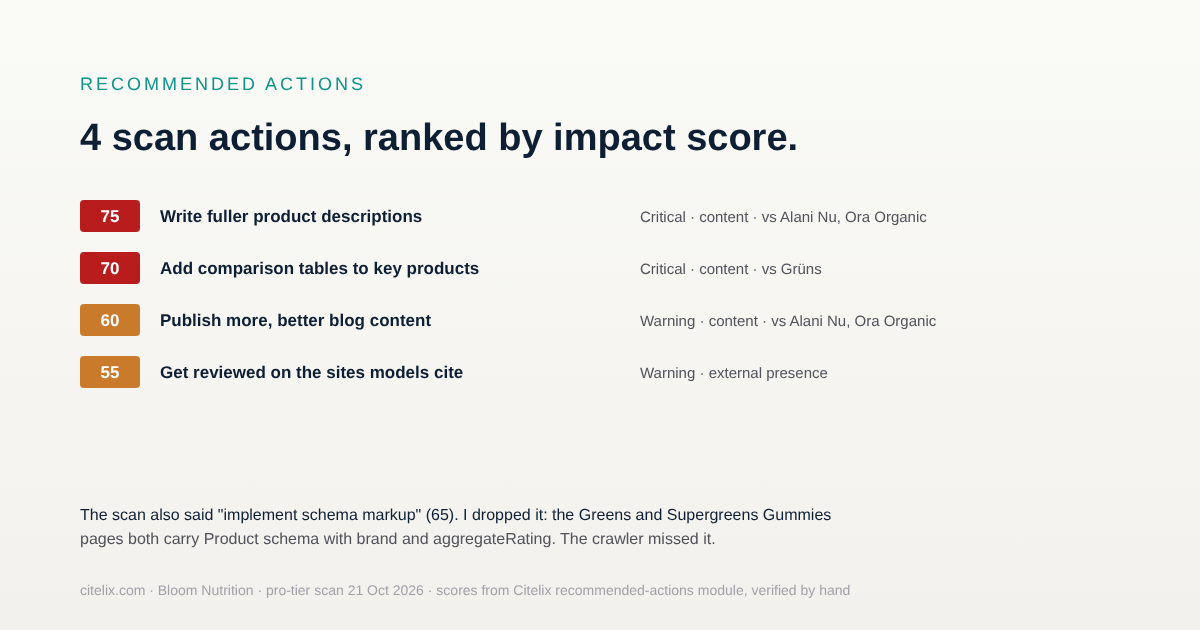
Why this matters: the scan’s 70-point action was comparison tables, and every model answered this prompt with a format comparison (gummy, liquid, powder). Bloom sells two of those formats and has no page comparing them.
How to do it: Write a guide on the existing blog, “Supplements without pills: gummies vs powder vs liquid,” with a table covering format, sugar, servings per day, and which Bloom product fits. Link it from both product pages and add FAQPage schema to /pages/faq at the same time.
Estimated time: half a day.
Fix 3: Get into the gummy and no-pill roundups the models cite
Why this matters: healthline.com, fortune.com, and verywellhealth.com were the top cited domains in this scan, and their roundups are where OLLY and SmartyPants get their “best for” labels.
How to do it: Pitch the editors of the “best gummy vitamins” and “best greens powders” lists with the Supergreens Gummies, leading with taste and the no-pill angle. The 15,423 reviews on Greens are the proof point.
Estimated time: 1 hour to send, weeks to land.
The 30-second version
If you only do one thing: put the words “no pills” on the gummies page. Bloom wins every prompt that names it and almost nothing else. The buyer who hates swallowing capsules is Bloom’s customer, and right now the models send her to OLLY because OLLY’s pages say what she is looking for and Bloom’s do not.
Methodology
I ran this scan through Citelix on 2026-10-21 (pro-tier, 20 prompts across ChatGPT, Gemini, Perplexity, Grok, and Claude, 100 responses in total, Claude collected via batch). The GeoScore of 28 is the final score after the Claude responses landed. The brand-aware split uses the scan’s per-response data; the discovery and share-of-voice counts come from searching the full text of the 85 discovery responses for each brand name, because the scan’s mention flag counted only 1 of the 5 discovery answers that name Bloom. Thorne, Garden of Life, Pure Encapsulations, and Nature Made were not among the 10 competitors the scan tracked. Site details come from bloomnu.com’s live product pages, product and collection feeds, FAQ, and sitemap on the same day.
Two data notes. The scan recommended “implement schema markup” (65), saying no schema was detected. Both product pages I checked carry Product schema with brand and rating data, so I left that action out. The scan also said only one blog post exists; the sitemap lists 5, which is still thin, so I kept the action. This teardown is independent and not sponsored by either brand.
Want this teardown for your store? Install Citelix on Shopify. We scan your store across ChatGPT, Gemini, Perplexity, Claude, and Grok every day and tell you exactly which prompts your competitors win and what to change.