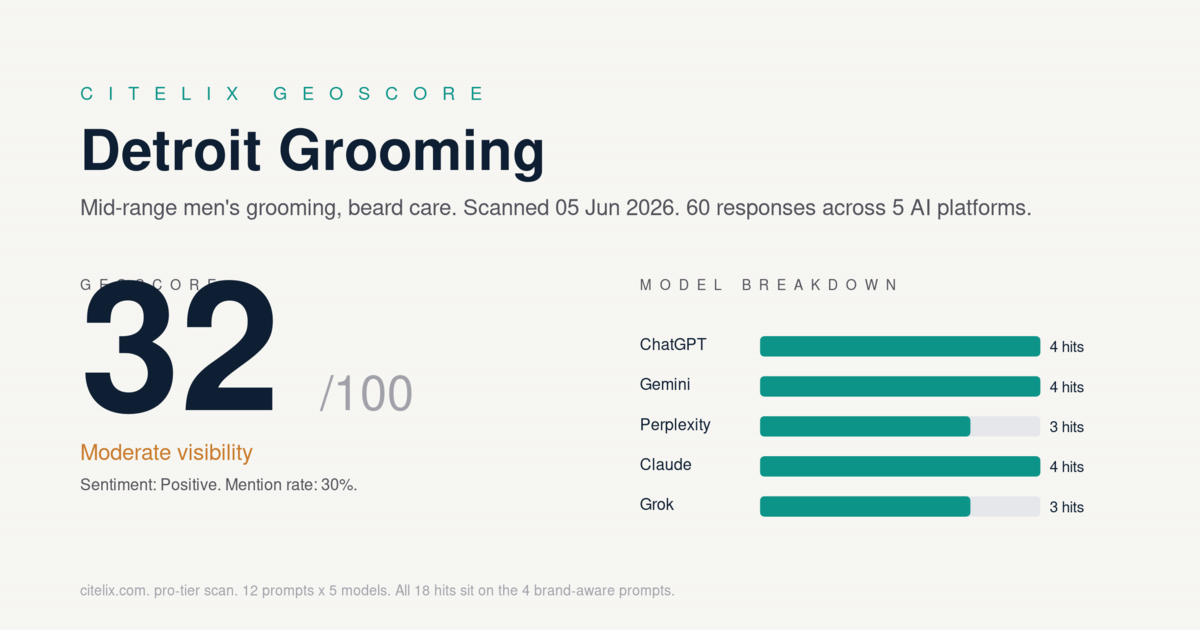
I ran a Citelix pro-tier scan on Detroit Grooming Co across ChatGPT, Gemini, Perplexity, Claude, and Grok: 12 buying-intent prompts, 60 total responses. On paper the brand looks fine. It posts a 30% mention rate and a positive sentiment read, and it sits at the top of the share-of-voice list for its category.
Then you split the data by prompt type and the floor drops out. Every single mention Detroit Grooming earned came from a prompt that already named the brand. On the prompts a real buyer types when they do not yet know who to buy from, the brand was invisible. Zero mentions across 40 responses.
A note on the brand name before we go further: the store sells under the storefront label “We Are Men’s Grooming,” which is how the AI models cite it. The 313 Duo and Traverse City Bundle in the responses are Detroit Grooming Co products (313 is Detroit’s area code), so this teardown treats the two names as the same company.
The prompt I tested
The brief prompt was “Best beard oil for dry skin.” The scan bundle ran a related 12-prompt set rather than that exact string, so the closest matches were “What is the best beard oil for sensitive skin in the mid-range price segment” and “How to fix dry and flaky skin around my beard.” Worth flagging as prompt drift. It does not soften the finding: Detroit Grooming was not mentioned in either of those, on any of the five models.
Why this prompt matters: dry, flaky, itchy beard skin is the exact problem a buyer wants solved when they go looking for a beard oil. The answer maps straight to a purchase. If the brand is absent here, it is absent at the moment of intent.
What the scan actually said
Across the 60 responses, Detroit Grooming was mentioned 18 times, a 30% mention rate. The per-model split:
- ChatGPT: 4 of 12 prompts
- Gemini: 4 of 12 prompts
- Perplexity: 3 of 12 prompts
- Claude: 4 of 12 prompts
- Grok: 3 of 12 prompts
That looks healthy until you see where those 18 hits live.
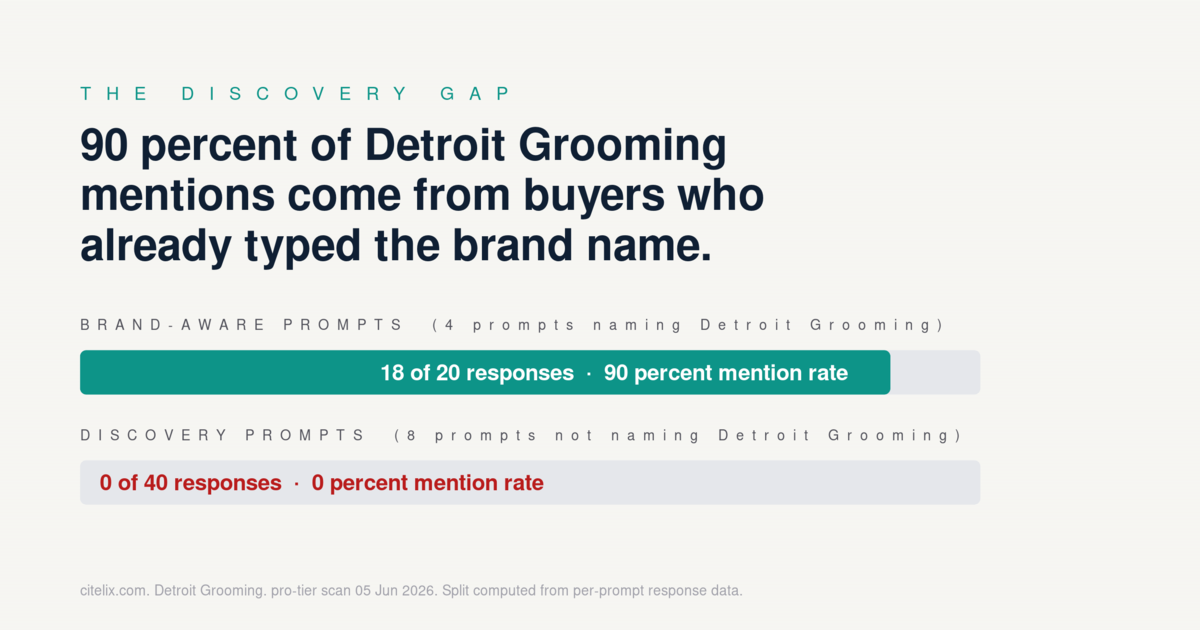
Four of the 12 prompts named the brand directly (comparisons like “Compare We Are Men’s Grooming beard butter and Beardbrand beard butter”). Those 4 prompts produced 18 of the 20 possible mentions, a 90% hit rate. The other 8 prompts were pure discovery: “best beard oil for sensitive skin,” “top brands for beard care under $30,” “how to fix dry and flaky skin,” “best products for a natural look that aren’t greasy.” Across all 40 of those responses, Detroit Grooming came up zero times.
So the 30% headline is really a 90% on questions where the buyer already knows the brand, and a 0% on questions where they do not. The mention rate is measuring brand recall, not discovery.
Share of voice is a mirage here
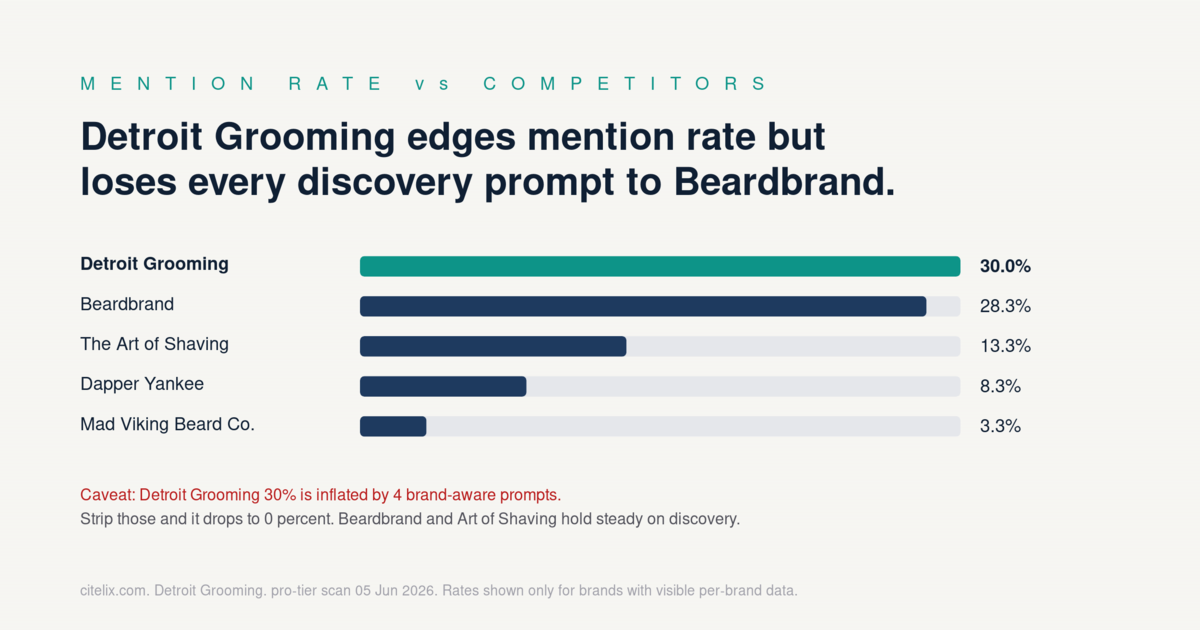
Detroit Grooming tops the leaderboard at 30%, just ahead of Beardbrand at 28.3%. The difference is that Beardbrand earns its number on discovery. It shows up under “top brands for beard care under $30,” “natural look,” “itchiness,” and the rest. The Art of Shaving (13.3%) and Dapper Yankee (8.3%) also surface on unbranded questions.
Strip the 4 brand-aware prompts out of Detroit Grooming’s total and the brand falls to 0%. Strip them out of Beardbrand’s and Beardbrand barely moves. That is the whole story: Detroit Grooming wins the prompts that need no winning and loses the ones that decide a new customer.
What Detroit Grooming is missing
The scan surfaced concrete, fixable gaps, all benchmarked against competitors that do show up on discovery:
- No blog. Beardbrand ranks partly because it has a deep library of beard-care content that models quote from. Detroit Grooming’s store has none.
- No comparison content. The Beard Club uses comparison tables the models can lift directly. Detroit Grooming does not.
- 211 product images with no alt text, so the catalog is hard for models to read and attribute.
- Collection pages with no descriptions, which removes the category-level text models use to match a query like “beard oil for dry skin.”
- No expert or customer quotations on product pages, which Dapper Yankee uses for credibility signals.
- No YouTube product demos, an external-presence signal Beardbrand leans on heavily.
3 fixes Detroit Grooming could ship this week
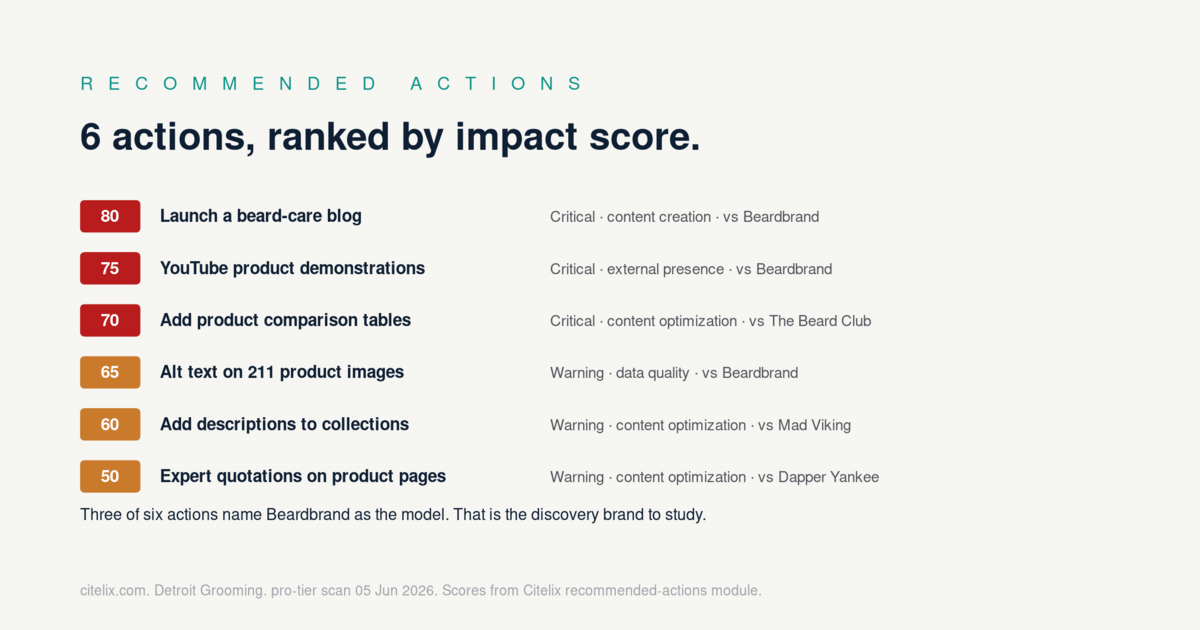
The Citelix module ranked six actions by impact score. Three are worth doing first, because each one attacks the discovery-prompt blind spot rather than the brand-aware prompts that are already won.
Fix 1: Publish 3 problem-led blog posts (impact score 80)
Why this matters: Models cite text that answers the question. Detroit Grooming has product pages but no editorial content, so there is nothing for a model to quote when someone asks “how do I fix dry, flaky beard skin.”
How to do it: In Shopify admin, open the blog section. Write three posts mapped to the dead discovery prompts: “How to fix dry and flaky skin under your beard,” “Best beard oil routine for sensitive skin,” and “Beard care under $30: what actually works.” Name the brand’s own products in each, with the active ingredient and what problem it solves. Keep each post 600 to 900 words with a clear question-style H1.
Estimated time: 1 day for drafts, 1 hour to publish.
Fix 2: Add a comparison table to your top 2 product pages (impact score 70)
Why this matters: Comparison tables are structured text models extract cleanly, and they let you appear in “compare X vs Y” answers on your own terms instead of waiting to be named.
How to do it: On the beard oil and beard butter product pages, add a simple HTML table comparing your product to a generic alternative across the attributes buyers care about for dry skin: carrier oils, scent load, greasiness, price per ounce. Use real numbers from your formulation.
Estimated time: 2 hours.
Fix 3: Write alt text and collection descriptions (impact score 65 and 60)
Why this matters: 211 images with no alt text and collections with no descriptions mean a large share of the catalog is invisible to the models doing the reading. This is the cheapest visibility you can buy.
How to do it: Batch the alt text in Shopify admin, leading with the product and use case (“Detroit Grooming beard oil for dry, flaky skin”). Then add a 2 to 3 sentence description to each collection page that names the problem the collection solves and the key ingredients.
Estimated time: 3 to 4 hours for both.
The 30-second version
If you only do one thing: publish the three problem-led blog posts. Detroit Grooming already wins when buyers type its name. The entire gap is on the discovery prompts, and discovery answers come from content that addresses the buyer’s problem in plain text. No new product, no ad spend.
Methodology
I ran a Citelix pro-tier scan on 05 Jun 2026 across ChatGPT, Gemini, Perplexity, Claude, and Grok: 12 prompts, 60 responses, web search enabled. The branded-versus-discovery split is computed only from per-prompt response data in the scan. Two data notes: the scan labels the brand by its storefront name “We Are Men’s Grooming,” and the prompt bundle ran related variants rather than the exact string “Best beard oil for dry skin.” This teardown is independent and not sponsored by either brand.
Want this teardown for your store? Install Citelix on Shopify. We scan your store across ChatGPT, Gemini, Perplexity, Claude, and Grok every day and tell you which prompts your competitors win and what to change.