Geometry named a product after the exact thing buyers want to stop using. It sells 331 designs of its Not Paper Towel, $15 for a set of six, made from post-consumer recycled materials.
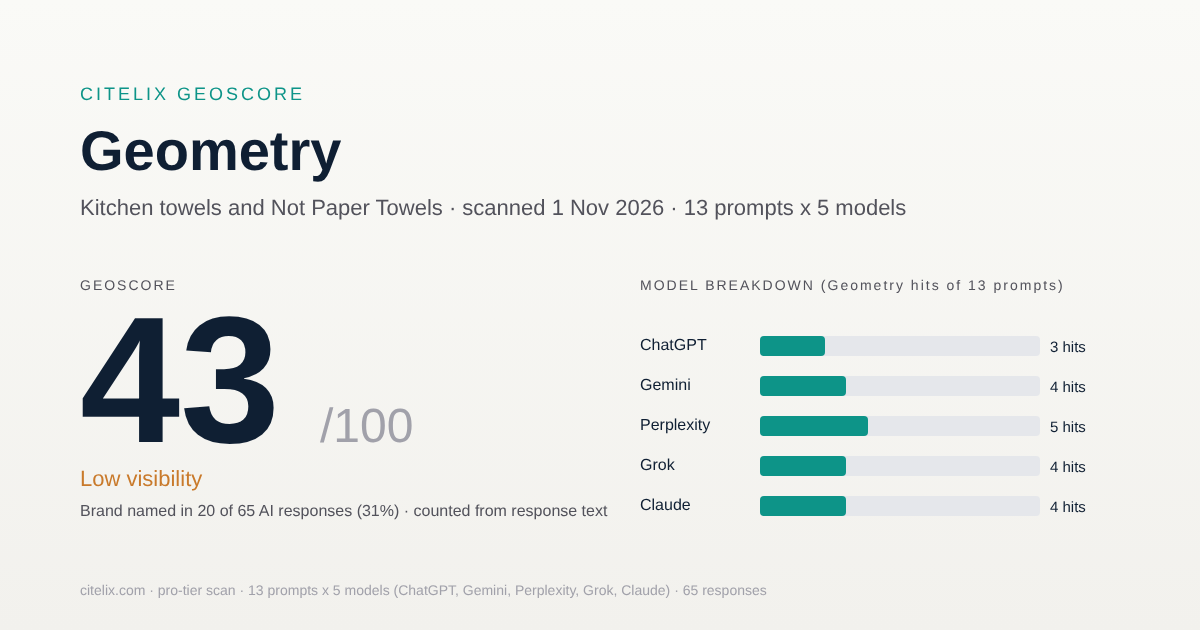
Ask AI for stylish reusable paper towels and Geometry mostly does not come up. Across ChatGPT, Gemini, Perplexity, Grok, and Claude, Geometry is named in 20 of 65 responses, and its Citelix GeoScore is 43 out of 100.
The prompt I tested
The scan ran 13 prompts. The anchor for this teardown:
“not paper towels that are reusable and stylish for eco conscious kitchens”
Why this prompt: it uses Geometry’s own product name, “not paper towels,” plus the two things Geometry sells on: design and sustainability. If Geometry cannot win this one, the product name is not doing its job.
What the AI models said
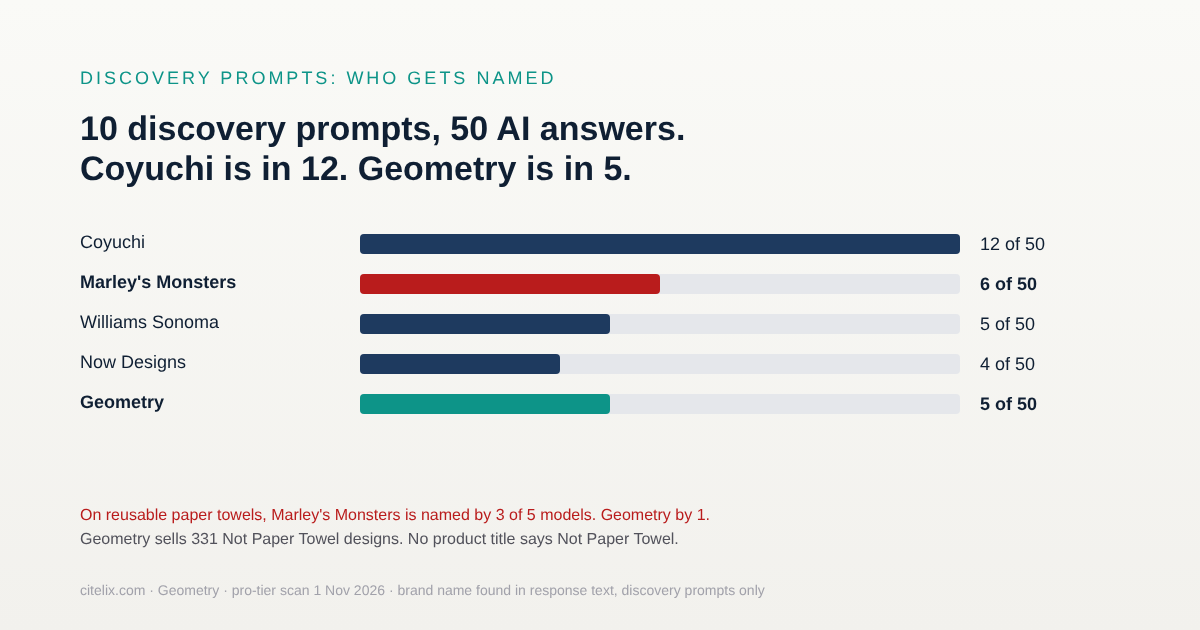
Marley’s Monsters was named by three models. Geometry was named by one.
- Gemini led with Swedish dishcloths, then “unpaper” cloth towels, and recommended Marley’s Monsters by print name: “Vintage Lemons,” “Cactus Toss,” and “Happy Clouds.” It also named the Zero Waste Store. No Geometry.
- Perplexity put Marley’s Monsters UNpaper Towels first in its table as “A direct paper-towel replacement.” Geometry was second, for “Design-conscious kitchens.”
- Grok led with Swedish dishcloths and listed Marley’s Monsters “Unpaper Towels” under reusable rolls. No Geometry.
- ChatGPT named Coyuchi, “Unpaper Towels by Swag,” and Bambooee. No Geometry.
- Claude recommended organic cotton towels, Swedish dishcloths, and Ecozoi bamboo towels. No Geometry.
The discovery gap
On the 3 prompts that name Geometry, the models name it in 15 of 15 answers. On the 10 that do not, they name it in 5 of 50.
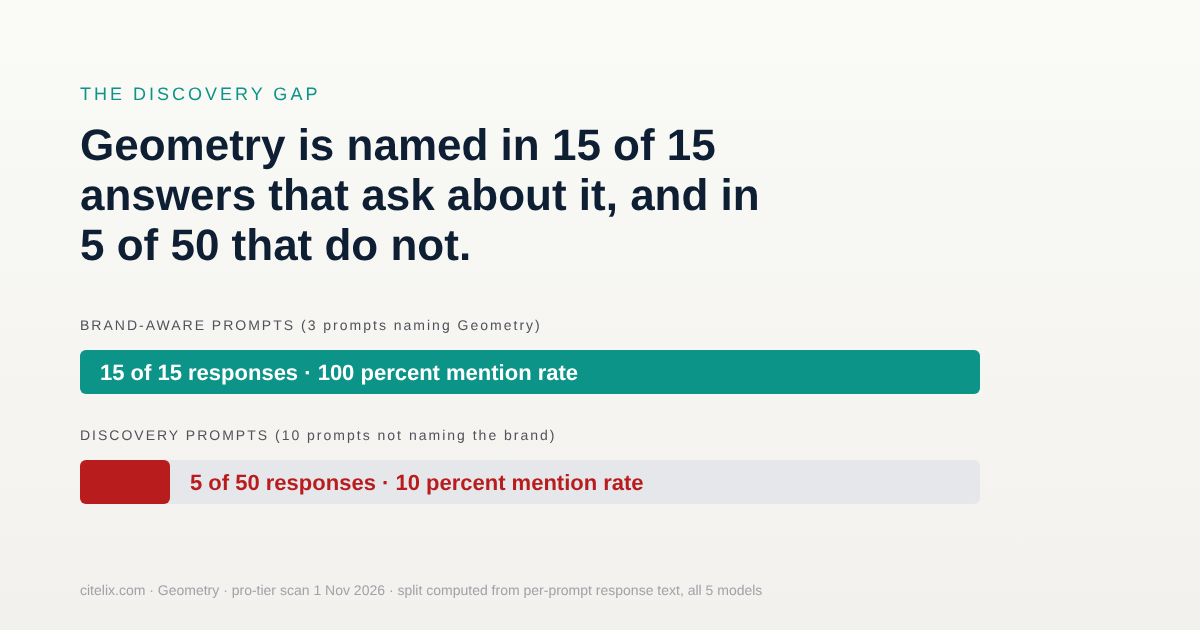
The models do know the product. On a different prompt, “how to choose a not paper towel that still feels premium,” Gemini said Geometry “is known for its” Not Paper Towels, and Claude named Geometry Not Paper Towels too. The knowledge is there. It just is not attached to the generic question.
Why Marley’s Monsters won
1. Its product names say what the product is
Marley’s Monsters titles its products like “UNpaper® Towels: Forest Forager 12-Pack.” Every product name carries the category. Geometry titles its Not Paper Towels by design only: “Christmas Lattice,” “Hanukkah is Here.” The page title adds “Not Paper Towel,” but the product name in the store feed and in the Product schema is just the design. Of 331 Not Paper Towel products, 0 have “Not Paper Towel” in the product title.
2. Geometry’s schema often names someone else as the brand
The Product schema on Geometry’s pages uses the vendor field as the brand. On “Christmas Lattice,” the brand in the schema is “Aubrey Fairchild,” the artist. On “Silly Snowman,” it is “Hufton Studio.” Across the store, 2,746 of 5,661 products have a vendor that is not Geometry. To a machine reading the schema, those are not Geometry products.
3. “Unpaper” became the category word
All five models used “unpaper” as a generic name for reusable paper towels in their answers to this prompt. Geometry’s term, “Not Paper Towel,” shows up in the prompt but not as a category the models recognize.
4. The models get Geometry’s material wrong
On “what makes a design forward towel different from a plain kitchen towel,” Grok described Geometry towels as “GOTS-certified organic cotton.” I found no product in Geometry’s feed that mentions GOTS or organic cotton. Geometry’s own pages say its towels are made from post-consumer recycled materials. For an eco-conscious buyer, that difference matters.
What Geometry is missing
I checked geometry.house by hand. The Not Paper Towels collection page has real copy and a meta description, and the product page lists the size (13.5” x 8.5”), the set of 6, and the recycled material. The page shows a “Based on 22,031 reviews” badge. The blog has 100 articles in the main sitemap, and the three I opened all load. Here is what is missing:
- The category in the product name, so “Christmas Lattice” becomes “Christmas Lattice Not Paper Towel (Set of 6).”
- Geometry as the schema brand on every product, with the artist named separately.
- A rating in the schema. The Product schema has no aggregateRating.
- An H1. The product page I checked has no H1 tag; the product name is an H2.
- A comparison page for Not Paper Towels vs Swedish dishcloths vs cotton unpaper towels. None of the 100 article URLs mentions paper towels.
3 fixes Geometry could ship this week
Fix 1: Fix the brand in the schema
Why this matters: on 2,746 products, the structured data tells AI the brand is an artist, not Geometry.
How to do it: Set the Product schema brand to “Geometry” on every product. Keep the artist as a separate property or in the description (“Design by Aubrey Fairchild”). This is a theme template change, not 2,746 edits.
Estimated time: 1 to 2 hours.
Fix 2: Put “Not Paper Towel” in the product name
Why this matters: the product name is what models and shopping feeds repeat. Right now it is a pattern name.
How to do it: Change the product name pattern for the 331 Not Paper Towels to “[Design] Not Paper Towel (Set of 6).” Do the same for tea towels and dishcloth sets. Most stores can do this with a bulk edit.
Estimated time: 2 to 3 hours.
Fix 3: Publish the comparison the models are making
Why this matters: every model compared Swedish dishcloths and unpaper towels. Geometry was missing from most of those lists.
How to do it: One page: Not Paper Towels vs Swedish dishcloths vs cotton unpaper towels. Material, size, how many replace a roll, wash care, and price per towel. State the material clearly: post-consumer recycled, not cotton.
Estimated time: half a day.
The 30-second version
If you only do one thing: change the schema brand to Geometry on every product. Geometry owns the phrase “not paper towel.” When a buyer uses it, four of five models still recommend someone else, and nearly half of Geometry’s catalog tells them the brand is somebody else.
Methodology
I ran this scan through Citelix on 2026-11-01 (pro-tier, ChatGPT, Gemini, Perplexity, Grok, and Claude, 65 responses in total, Claude collected via batch). The GeoScore of 43 is the scan’s final score after the Claude responses landed.
The scan needed fixing before it ran. Its crawler read the brand as “Luxe Kitchen Towel,” which is one of Geometry’s product types, and generated 10 prompts with that name. I deleted those 10. Three of the scan’s own discovery prompts were deleted by mistake in the same step, and I added them back with the same wording. I then added three prompts that name Geometry. That leaves 13 prompts: 3 brand-aware and 10 discovery. I counted Geometry mentions myself with a case-sensitive whole-word match, and read each matched snippet to rule out the ordinary word “geometry.”
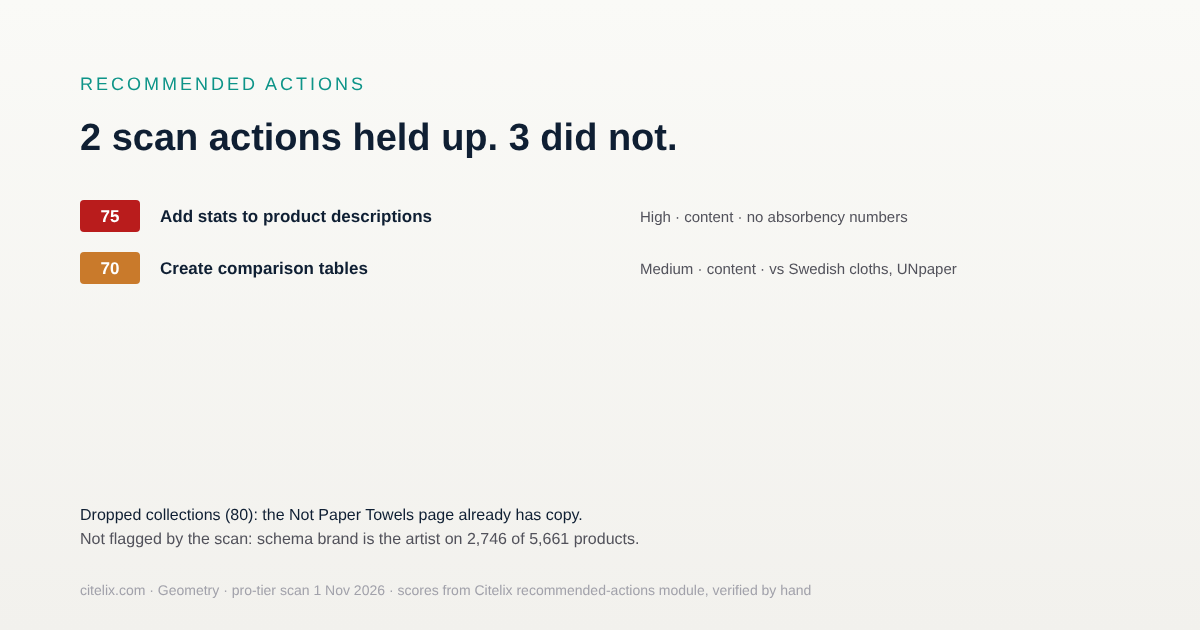
I left out “Enhance Collection Pages with Descriptions” (80), because the Not Paper Towels collection already has copy and a meta description, and “Create a Blog” (75), because the blog has 100 articles. I also left out “Implement Expert Quotations” (65) as lower impact. Coyuchi, Now Designs, and Williams Sonoma counts are whole-word matches in the 50 discovery answers; Marley’s Monsters was not in the scan’s tracked competitor list. Site details come from geometry.house, its product feed, and its sitemap, checked on 2026-11-01. Marley’s Monsters product names come from marleysmonsters.com the same day. This teardown is independent and not sponsored by either brand.
Want this teardown for your store? Install Citelix on Shopify. We scan your store across ChatGPT, Gemini, Perplexity, Claude, and Grok every day and tell you exactly which prompts your competitors win and what to change.