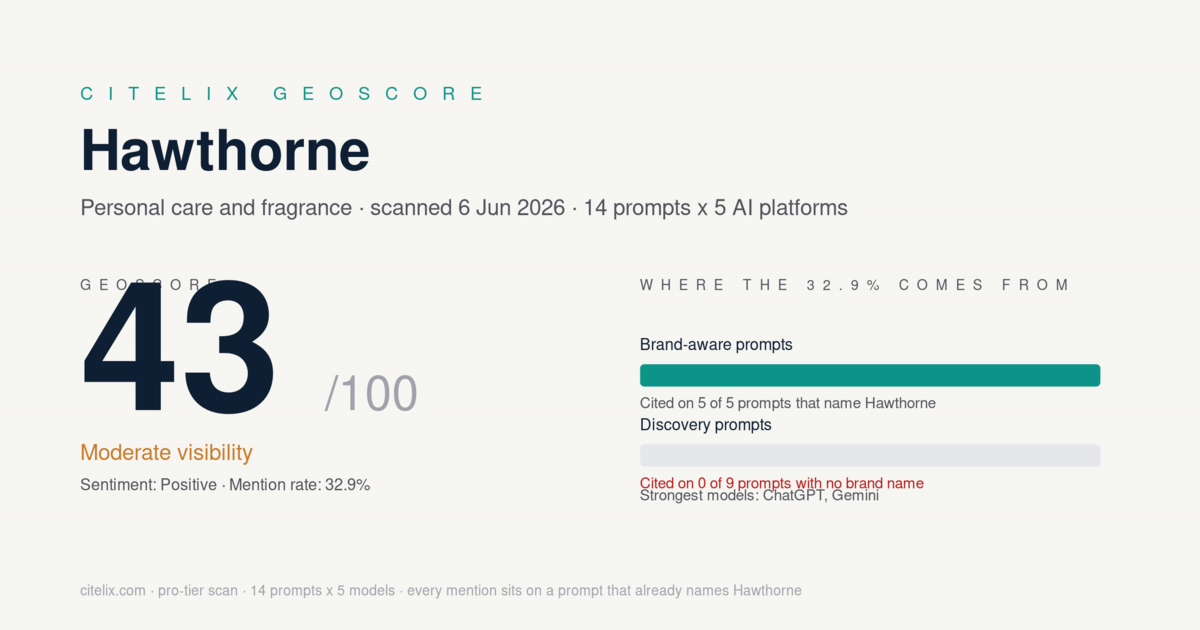
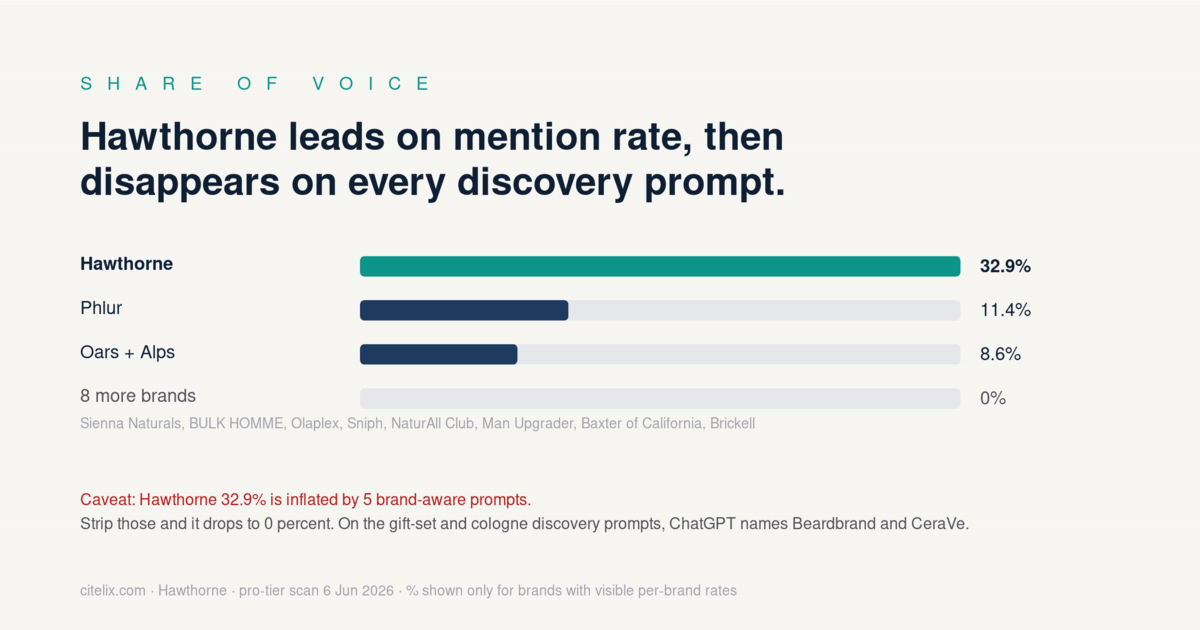
Hawthorne looks healthy at a glance. We ran a Citelix pro-tier scan across ChatGPT, Gemini, Perplexity, Claude, and Grok on 6 June 2026: 14 prompts, 5 platforms. Hawthorne came back with a 32.9% mention rate and positive sentiment, the highest mention rate of any brand in the scan. Phlur was a distant second at 11.4%, Oars + Alps third at 8.6%.
So why does the GeoScore land at 43, only moderate visibility? Because of where those mentions sit. Every single Hawthorne citation comes from a prompt that already names Hawthorne or one of its products. On the prompts a new buyer actually types, the ones with no brand name in them, Hawthorne is invisible.
The prompt I tested
The brief prompt for this teardown was “Best men’s grooming gift set under $75.” The scan ran the gift-set and bundle intent as a cluster of discovery prompts: “top grooming sets for men that are affordable but high-quality,” “best scent bundles for men who want a versatile fragrance collection,” and “what is the best long-lasting cologne for men at a mid-range price.”
Why this cluster: this is exactly the buyer Hawthorne was built for. Hawthorne’s whole model is curated, gift-ready grooming and fragrance sets. If it cannot get cited when someone asks an AI for the best grooming gift set under $75, it is losing its core customer at the moment of discovery.
What ChatGPT said
On “top grooming sets for men that are affordable but high-quality,” here is who ChatGPT named, verbatim from the scan:
Here are some affordable yet high-quality grooming sets for men. 1. Beardbrand Utility Balm: versatile balm, great for beard care and skin hydration, natural ingredients like shea butter and jojoba oil, around $20. 2. CeraVe Hydrating Cleanser and Moisturizing Cream Set: highly recommended by dermatologists, gentle yet effective.
Hawthorne was not mentioned. On the mid-range cologne prompt, ChatGPT recommended designer houses (Acqua di Gio Profumo, Bleu de Chanel) and again did not name Hawthorne.
The split across the 14 prompts:
- Brand-aware prompts (5 prompts that name Hawthorne or its products like Night Swim and Frozen Flame): cited on all 5.
- Discovery prompts (9 prompts with no brand name): cited on 0.
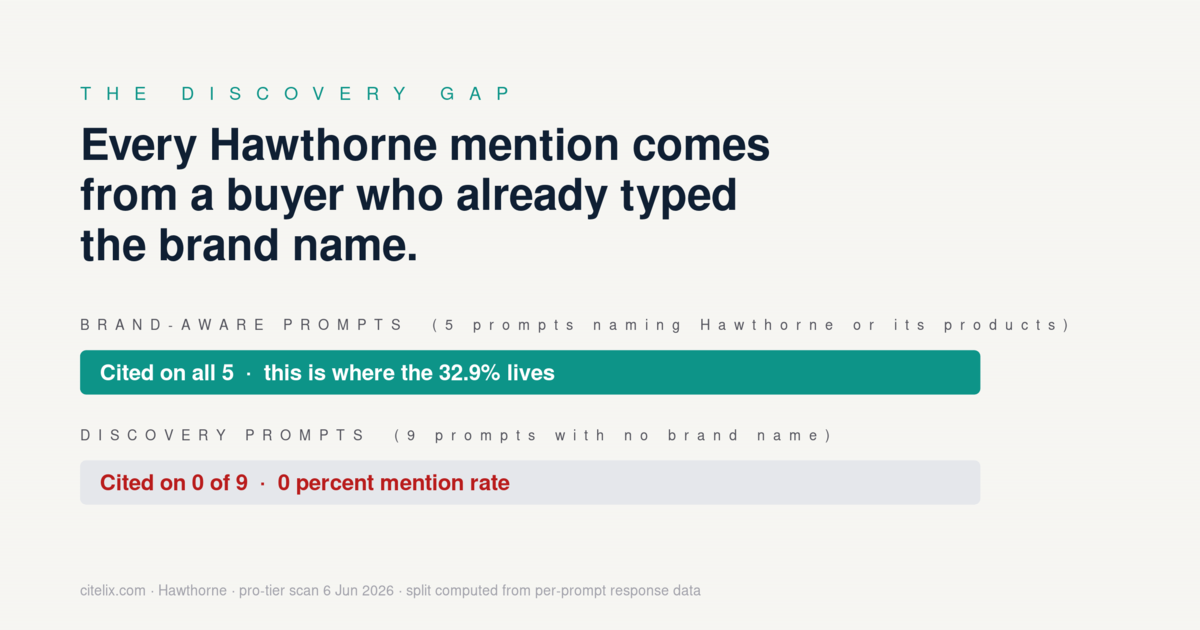
That is the entire story of the 43. The 32.9% mention rate is real, but it is a brand-defense number, not a discovery number. It tells you Hawthorne’s existing customers and reviewers are feeding the models. It tells you nothing about whether a new buyer will find them.
Share of voice
On raw mention rate, Hawthorne leads. Strip the brand-aware prompts and the leaderboard inverts: Hawthorne drops to 0% on discovery, and the brands that show up are designer fragrance houses and broad grooming names like Beardbrand and CeraVe, not the DTC fragrance competitors.
- Hawthorne: 32.9%, positive sentiment
- Phlur: 11.4%, neutral
- Oars + Alps: 8.6%, neutral
- Eight more brands (Sienna Naturals, BULK HOMME, Olaplex, Sniph, NaturAll Club, Man Upgrader, Baxter of California, Brickell): 0%
Phlur matters here. It is the one DTC competitor with real discovery share, and the Citelix scan flags Phlur as a brand using structured data effectively while Hawthorne is not. That is a direct, fixable gap.
What Hawthorne is missing
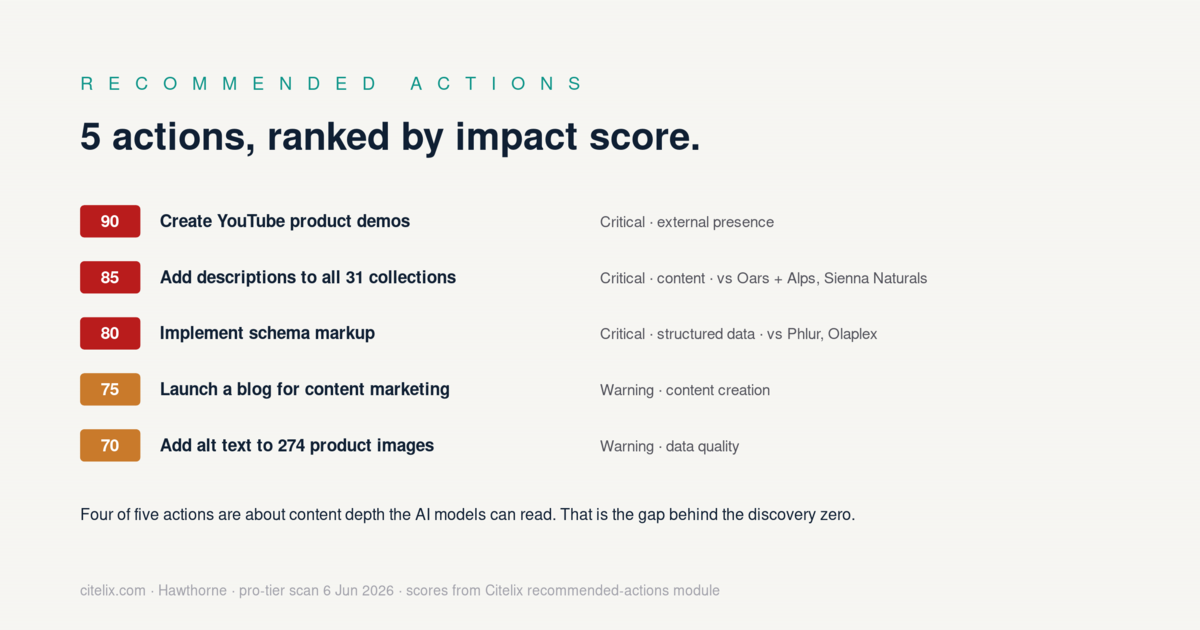
The Citelix recommended-actions module scored five fixes for Hawthorne. Four of the five are about the same root problem: the product and collection pages do not give an AI model enough readable, structured content to cite Hawthorne on a generic prompt.
The specifics from the scan:
- 0 of 31 collections have descriptions. Competitors like Oars + Alps and Sienna Naturals have rich collection-page content.
- No schema markup detected on the site. Phlur and Olaplex use structured data.
- No blog. There is no content surface for the models to pull “best grooming set” context from.
- 274 product images are missing alt text.
3 fixes Hawthorne could ship this week
None of these require new product or ad spend.
Fix 1: Write descriptions for all 31 collections, starting with the gift sets
Why this matters: A collection page with no description is a blank page to an AI model. It cannot cite what it cannot read. Hawthorne’s gift-set and bundle collections are exactly the pages that should rank for the prompt it is losing.
How to do it: In Shopify admin, go to Products, then Collections. For each gift-set or bundle collection, add a 100 to 200 word description that uses the buyer’s language: “grooming gift set under $75,” “scent bundle,” “starter set for men.” Name what is in the set, who it is for, and the price band. Save.
Estimated time: 2 to 3 hours for the priority gift-set collections.
Fix 2: Add product and Offer schema to the gift-set pages
Why this matters: Schema is how a model reliably reads price, contents, and review count. Phlur and Olaplex already do this. It is the single fastest way to become machine-citable on a price-bounded prompt like “under $75.”
How to do it: Use a schema generator or a Shopify app to add Product schema (name, description, price, aggregateRating) to the gift-set pages. Confirm the price field is populated so the “under $75” filter can match. Validate with Google’s Rich Results test.
Estimated time: 1 to 2 hours.
Fix 3: Publish one “best grooming gift sets under $75” guide
Why this matters: Hawthorne has no blog, so there is no editorial page for a model to pull from on a discovery prompt. A single honest guide that includes Hawthorne’s own sets gives the models a citable source.
How to do it: Write one 800 to 1200 word guide titled for the exact prompt. List real sets with prices and who each suits. Link to the collection pages from Fix 1. Keep it useful, not a sales page.
Estimated time: 3 to 4 hours.
The 30-second version
If you only do one thing: write descriptions for the gift-set collections (Fix 1). Hawthorne’s mention rate proves the models already trust the brand. The only reason it loses discovery prompts is that its highest-intent pages are blank to a machine. Give them something to read.
Methodology
I ran this scan in Citelix on 6 June 2026 across ChatGPT, Gemini, Perplexity, Claude, and Grok, 14 prompts in total. The brand-aware versus discovery split is computed from per-prompt response data. Two fidelity notes: the brief’s exact prompt “Best men’s grooming gift set under $75” was run as an equivalent cluster of gift-set, bundle, and mid-range cologne discovery prompts rather than that single string, and Hawthorne scored 0 on every one of them. The per-model breakdown bar chart in the dashboard was not machine-readable, so model-level counts are not reported here; the competitor table lists ChatGPT and Gemini as Hawthorne’s strongest models. This teardown is independent and not sponsored by either brand.
Want this teardown for your store? Install Citelix on Shopify. We scan your store across ChatGPT, Gemini, Perplexity, Claude, and Grok every day and tell you exactly which prompts your competitors win and what to change.