Kettle & Fire is the bone broth most people have actually seen on a shelf. It also sells a regenerative line: a Regenerative Beef Bone Broth and a Regenerative Chicken Bone Broth at $9.49 a carton, plus bison and venison broths and a grass-fed beef tallow, all tagged “Regenerative” in its catalog.
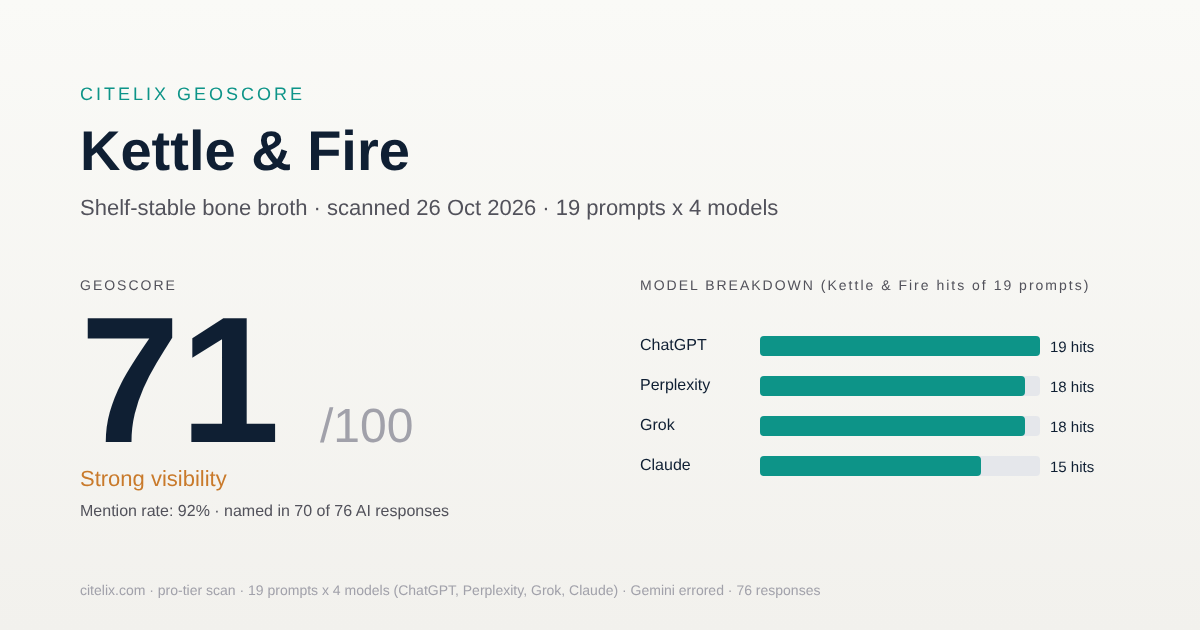
So I expected Kettle & Fire to lead when I asked the models which bone broth brand has the cleanest ingredients and regenerative sourcing. I scanned the brand across ChatGPT, Perplexity, Grok, and Claude this week (Gemini errored, more on that below). The headline numbers are excellent: a Citelix GeoScore of 71 out of 100, named in 70 of 76 answers. On the regenerative prompt, Kettle & Fire was named in all 4 answers. It was the first brand named in 0 of them. FOND was first in 3.
The prompt I tested
The scan ran 19 bone broth prompts. The anchor for this teardown:
“which bone broth brand has the cleanest ingredients and regenerative sourcing”
Why this prompt: this buyer has already decided to pay more for sourcing. They are not asking whether bone broth is good for them, they are asking which brand to trust. In an answer like that, the first name gets the click. Being fifth on the list is close to not being there.
What Perplexity said
Perplexity opened with one sentence: “FOND Bone Broth is the strongest overall match for clean ingredients plus regenerative sourcing,” citing pasture-raised regenerative bones, glass jars, verified regenerative sourcing, and heavy-metal testing. Its comparison table then ran FOND, Bonafide Provisions, Brodo, Miller’s Bio Farm, and Paleovalley. Kettle & Fire was the sixth row.
The other models:
- Claude said “FOND stands out as the top choice,” called it “the first verified regenerative bone broth brand,” and closed with “FOND appears to be the leading choice in the market.” Kettle & Fire came second, described as a brand that “has become involved in regenerative sourcing.”
- ChatGPT led with FOND as “the first verified regenerative bone broth on the market,” then Miller’s Bio Farm, then Kettle & Fire, citing a press release about Kettle & Fire’s regenerative line launch.
- Grok led with Bonafide Provisions and put Kettle & Fire second, adding that Kettle & Fire does “not yet carry a formal regenerative certification.”
Every model knows Kettle & Fire has a regenerative story. None of them treats it as the answer.
The discovery gap
Kettle & Fire’s problem is not visibility. It is rank on the questions that decide a premium purchase.
- Brand-aware prompts (12): named in 48 of 48 answers.
- Discovery prompts (7): named in 22 of 28 answers, about 79%. Claude accounted for 4 of the 6 misses, on immune, autoimmune, and inflammation questions.
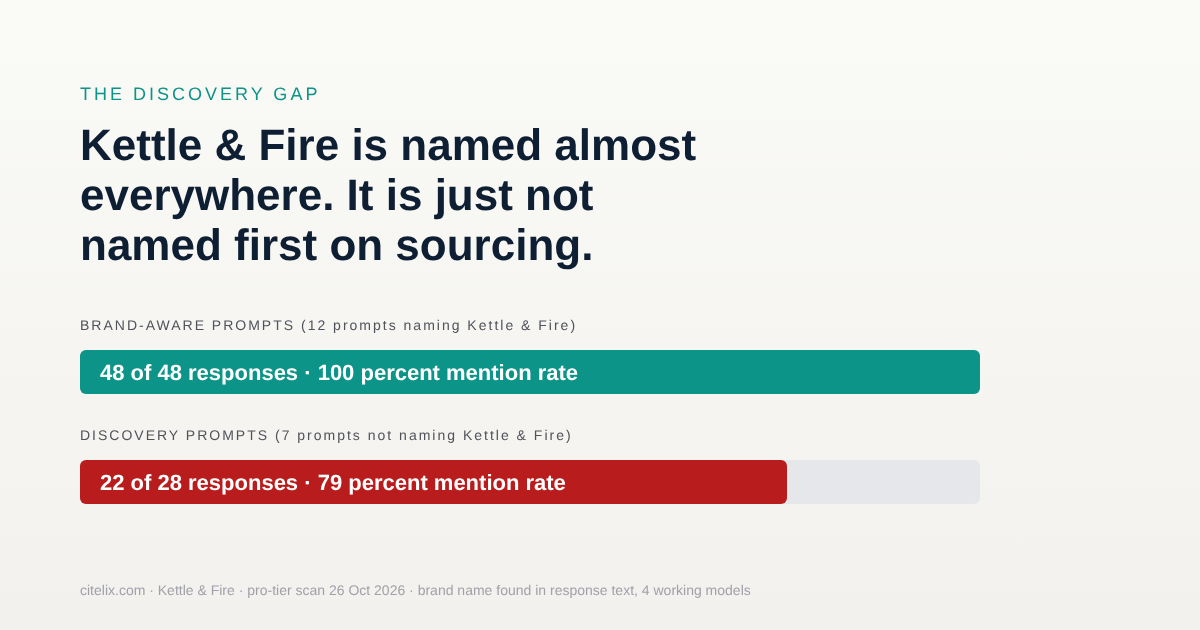
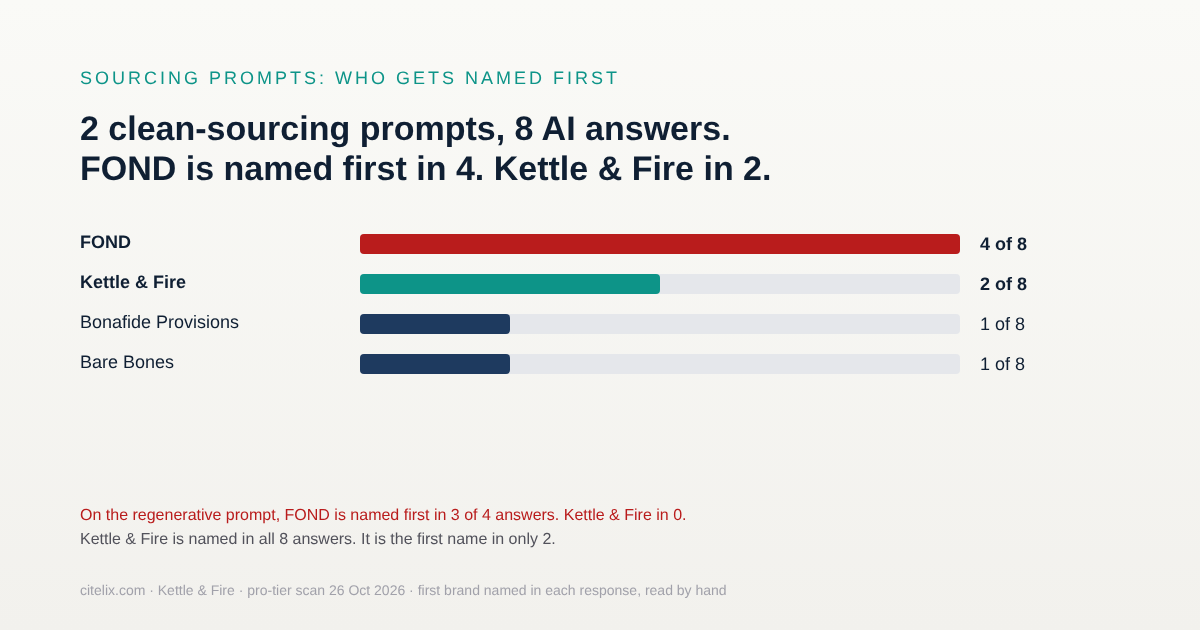
Most brands I scan would kill for 79% discovery. But look at the two sourcing prompts together. On “top bone broth brands for clean label ingredients and sustainable sourcing,” Kettle & Fire was named first by ChatGPT and Grok. On the regenerative prompt, it was first in none. Across the 8 answers, Kettle & Fire is named in all 8 and first in 2. FOND is first in 4.
Why FOND won the regenerative prompt
I read all four answers, the sources they cited, and both brands’ sites. Four things stand out.
1. FOND says “verified” and “certified,” and Kettle & Fire does not
FOND’s homepage says it is “the first verified regenerative bone broth brand.” Its about page says “Certified Regenerative” over and over. Three of the four models repeated that “verified” language almost word for word. Kettle & Fire’s Regenerative Beef page says the broth is “made with 100% grass-fed beef bones raised using regenerative agriculture.” The only certification on that page is “Certified Glyphosate Residue Free.” No verifier, no farm, no standard. That is exactly the gap Grok called out.
2. FOND’s whole domain is the keyword
The site is fondregenerative.com. Every page, every citation, every product link carries the word. Claude cited fondregenerative.com directly. Kettle & Fire’s regenerative products live on kettleandfire.com next to more than 90 other products, and the “Regeneratively Made Broths” menu link goes to a filtered app page (/a/collections/products?filters=regenerative+broths) rather than a normal collection page with its own description. /collections/regenerative returns a 404.
3. Kettle & Fire’s regenerative product data is broken
The Regenerative Beef Bone Broth’s product description, the text in its feed and in its Product schema, starts with a pasted block of Figma metadata and then gives one sentence: “Beef bone broth made with grass-fed cow bones raised using regenerative agriculture.” That is 84 characters of usable copy. A crawler or shopping agent reading structured data gets less about this product than a human gets from the page.
4. FOND writes about sourcing, Kettle & Fire’s content does not
FOND’s sitemap lists 233 articles. Kettle & Fire has more content in total: a 278-URL blog on blog.kettleandfire.com and a 68-URL learning library on learn.kettleandfire.com. But none of those URLs is about regenerative sourcing, farms, or certification. The models filled that gap from FOND’s site, review roundups like getcrunchy.co and consumerreports.org, and a press release.
What Kettle & Fire is missing
I checked kettleandfire.com and both content subdomains by hand. For this prompt:
- A verifiable regenerative claim. No named certification, verifier, or farm partner on the regenerative product pages.
- A real regenerative collection page. The menu link is an app filter, and there is no crawlable page that explains the line.
- Clean product data. The Regenerative Beef description is Figma metadata plus one sentence. The Product schema on that page and on the 32 oz Beef Bone Broth page has no AggregateRating, even though the 32 oz page shows 174 reviews.
- Real authors. The learning library’s sitemap includes author pages for “Dwight Schrute,” “Michael Scott,” and “Pam Beasley.” The two I opened have lorem ipsum bios. They are template placeholders, but they are in the sitemap, and they sit on the domain models read to judge expertise.
- FAQPage markup. /pages/faq has a long list of answers and no structured data at all.
3 fixes Kettle & Fire could ship this week
None of these need a new product.
Fix 1: Make the regenerative claim checkable
Why this matters: three models led with FOND because FOND says “verified.” Grok said outright that Kettle & Fire lacks a formal certification. Models repeat the specific claim, not the general one.
How to do it: On every regenerative product page, add two or three sentences that name the standard. If the bones come from certified or verified farms, name the certifier and the farms. If they do not, say exactly what “regenerative” means for this line: which practices, which farms, how it is checked. Then build a real collection page, /collections/regenerative-bone-broth, with that same copy at the top, and point the menu at it.
Estimated time: half a day, plus however long it takes to get the farm details from sourcing.
Fix 2: Clean up the product data
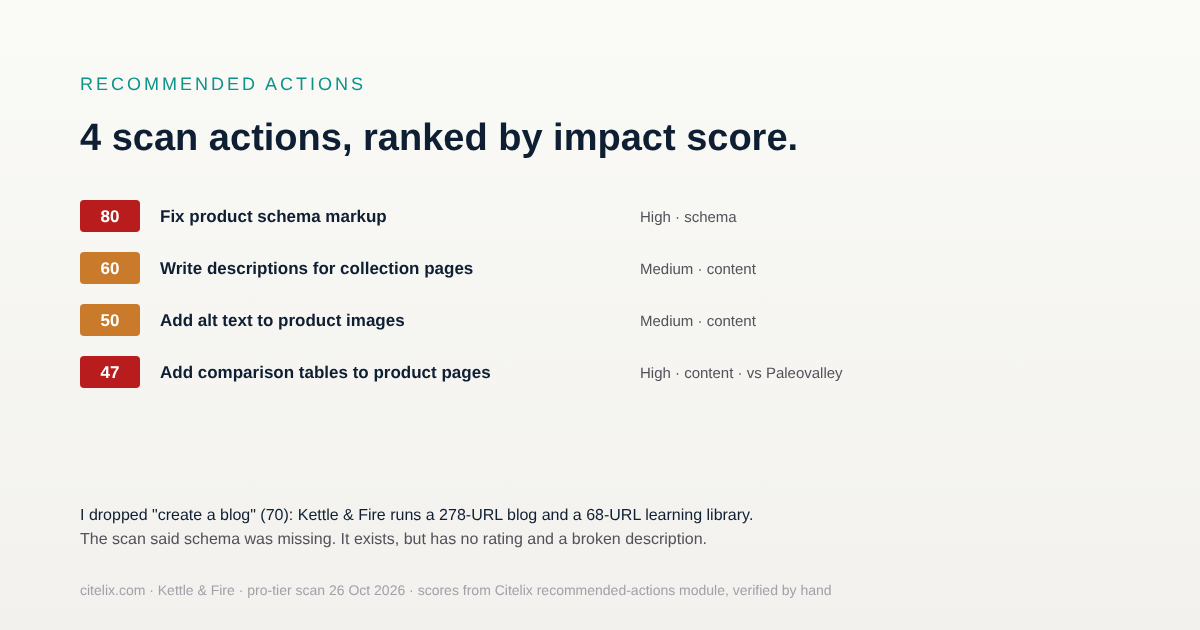
Why this matters: the scan’s top action (80) was schema. The scan said schema was missing, which is not quite right. It exists, but it carries a Figma comment instead of a description and no rating.
How to do it: Strip the Figma metadata from the Regenerative Beef description and write a real 100 to 150 word description that includes the sourcing standard from Fix 1. Add AggregateRating to the Product schema using the review data already on the page. Add FAQPage schema to /pages/faq. Check the result in Google’s Rich Results Test.
Estimated time: 2 hours for a developer.
Fix 3: Publish one sourcing article and remove the placeholder authors
Why this matters: Kettle & Fire has 346 content URLs across two subdomains and none of them answers “where do your bones come from?” The models answered it for them using FOND’s site and a press release.
How to do it: Publish “How Kettle & Fire sources regenerative bones” on the learning library, with farm names, practices, photos, and a named author, and link it from every regenerative product page. Delete or noindex the Dwight Schrute, Michael Scott, and Pam Beasley author pages.
Estimated time: 1 day.
The 30-second version
If you only do one thing: name the standard behind the word “regenerative” on your own product pages. Kettle & Fire is named in 70 of 76 AI answers, which is a great number. But on the regenerative prompt, FOND was named first in 3 of 4 answers and Kettle & Fire in 0, because FOND says “verified” and Kettle & Fire’s page gives the models nothing specific to repeat.
Methodology
I ran this scan through Citelix on 2026-10-26 (pro-tier, 19 prompts across ChatGPT, Gemini, Perplexity, Grok, and Claude, Claude collected via batch and complete). All 19 Gemini calls came back empty, so this teardown uses the 76 responses from the other four models. The GeoScore of 71 is the scan’s final score on those responses. Every mention count comes from searching the full response text for “Kettle & Fire” or “Kettle and Fire.” “First brand named” was read by hand, response by response, because the scan’s position field only ranks tracked competitors and ignores brands like Bonafide Provisions. Bonafide Provisions and Miller’s Bio Farm were not among the 10 competitors the scan tracked. Site details come from kettleandfire.com’s product feed, sitemaps, FAQ page, and product pages, from learn.kettleandfire.com and blog.kettleandfire.com sitemaps, and from fondregenerative.com, on the same day.
Data notes: the scan recommended “create a blog” (70), saying Kettle & Fire has no blog posts. Its blog lives on a subdomain with 278 URLs, plus a 68-URL learning library, so I left that out. The scan also said schema markup was not detected; Product schema is present but incomplete, so I kept the action and reframed it as a fix. This teardown is independent and not sponsored by either brand.
Want this teardown for your store? Install Citelix on Shopify. We scan your store across ChatGPT, Gemini, Perplexity, Claude, and Grok every day and tell you exactly which prompts your competitors win and what to change.