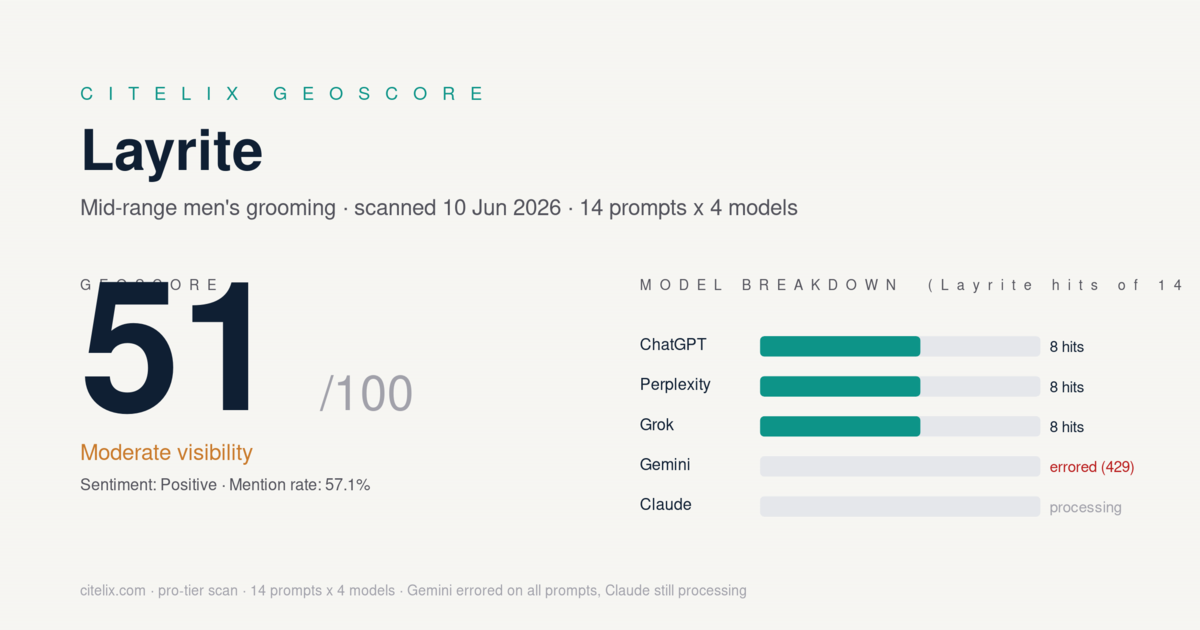
Layrite has been making barber-grade, water-soluble pomade since 1999. So when I scanned the brand across ChatGPT, Perplexity, and Grok this week, I expected it to dominate. In a way it does: Layrite landed a 57.1% mention rate and a Citelix GeoScore of 51 out of 100, with positive sentiment. That is real visibility, not a brand the models have never heard of.
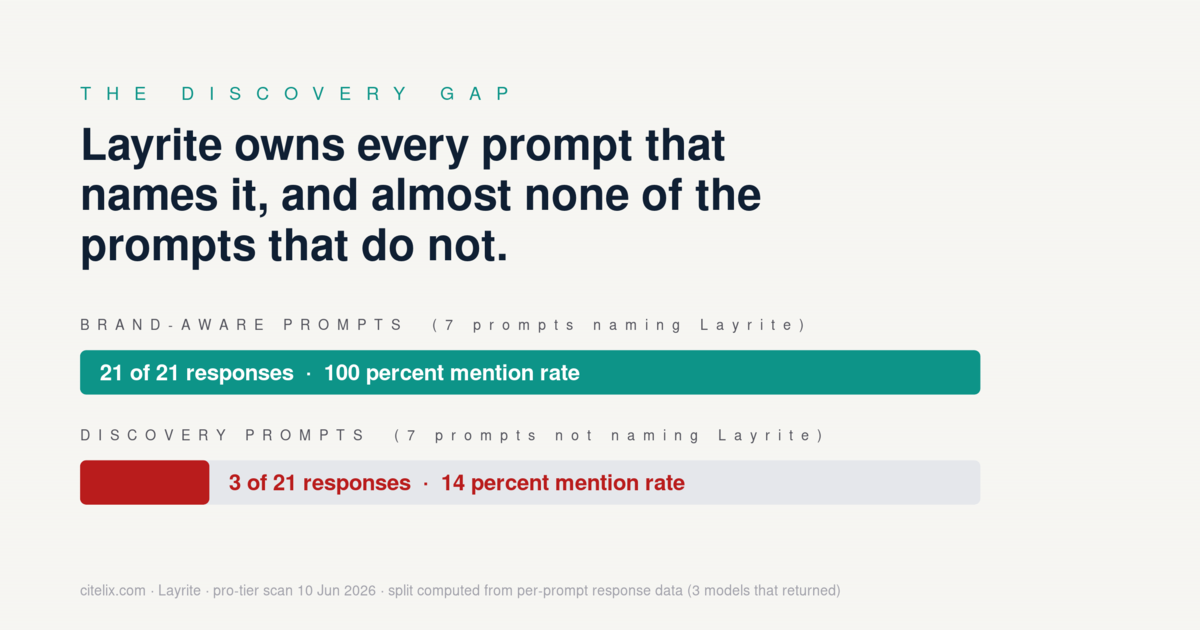
But the headline number hides the actual story. Layrite gets cited in 100% of the prompts that already say the word “Layrite,” and in only 14% of the prompts where a buyer describes what they want without naming a brand. When someone types “what’s the best water-soluble pomade for classic hairstyles,” ChatGPT leads with Suavecito Original and lists Layrite second. On Grok, Layrite does not show up at all. That is the prompt a buyer with a credit card actually types, and it is the one Layrite is losing.
The prompt I tested
The scan bundled 14 styling prompts. The cleanest discovery prompt in the set was:
“what’s the best water-soluble pomade for classic hairstyles”
Why this prompt: it is high commercial intent and brand-agnostic. The buyer knows the category (water-soluble pomade) and the use case (classic slick-back, side part, pomp) but has not picked a brand yet. Whoever the model names first has a real shot at the sale. This is exactly the moment Layrite should win on reputation and it does not.
What ChatGPT said
On the open pomade prompt, ChatGPT put Suavecito Original first and Layrite second, with Reuzel, Baxter of California, and American Crew also cited:
Here are some of the best water-soluble pomades for classic hairstyles: 1. Suavecito Original … 2. Layrite Deluxe … medium hold, good for thick hair, lightweight texture. Cons: slightly more expensive than others. 3. …
Perplexity ran the same way, citing Layrite at position 3 behind the bigger names. Grok did not mention Layrite on this prompt at all. Gemini errored on every prompt in the scan (a 429 billing error on Google’s side), and the Claude column was still processing at scan time, so this teardown is built on the three models that returned data: ChatGPT, Perplexity, and Grok.
Now compare that to the branded prompts. On “Layrite Deluxe vs Suavecito which one holds better for thick hair,” “how to style a modern undercut with Layrite Deluxe products,” and “which Layrite product is best for achieving a matte finish,” Layrite was cited at position 1 on all three working models, every time, often with positive sentiment. The models clearly know Layrite is good. They just do not reach for it first when the buyer has not named it.
Here is the same split, per platform:
- ChatGPT: 8 of 14 prompts cite Layrite (57.1%). Position 1 on every branded prompt, position 2 on the open pomade prompt.
- Perplexity: 8 of 14 prompts cite Layrite (57.1%). Same pattern, position 3 on the open pomade prompt.
- Grok: 8 of 14 prompts cite Layrite (57.1%). Strong on branded prompts, absent on the open pomade prompt.
- Gemini: errored on all 14 prompts (Google API 429). No data.
- Claude: still processing via the batch API at scan time. No data yet.
Why Suavecito won the open prompt
I read every response and clicked through to the sites. Four things put Suavecito and the other discovery winners ahead of Layrite when no brand is named:
1. Suavecito has the category-defining anchor
Suavecito Original is the reference point models reach for when describing “classic water-soluble pomade.” It is mentioned as the baseline that other pomades get compared against. Layrite has the heritage to own that anchor (1999, barber-created) but the models are not repeating that positioning, because Layrite’s own pages do not state it in a quotable, structured way.
2. Competitors publish structured comparison content
Reuzel and Hanz de Fuko have comparison tables that lay out hold, shine, and finish side by side. ChatGPT and Perplexity quote that structure directly. When a model needs to say “this pomade has medium hold and low shine,” it pulls from a page that already says exactly that in a table.
3. The discovery winners have blogs
Suavecito and Uppercut Deluxe run content-rich blogs with styling guides and product explainers. That gives the models a deep, on-topic corpus to cite for open prompts like “best pomade for classic hairstyles.” Layrite has product pages, but very little surrounding editorial content for AI to draw on.
4. Their product data is cleaner
Competitors like Baxter of California carry FAQ pages and richer product descriptions. Models prefer sources where the answer is already written out. Layrite’s pages assume you already know the brand, which works for branded prompts and fails for open ones.
Share of voice
Across the brands with visible per-brand mention rates in the scan, Layrite leads comfortably:
- Layrite: 57.1%
- Reuzel: 19%
- Baxter of California: 11.9%
- American Crew: 11.9%
- Uppercut Deluxe: 9.5%
- Hanz de Fuko: 7.1%
- Suavecito Pomade: 4.8%
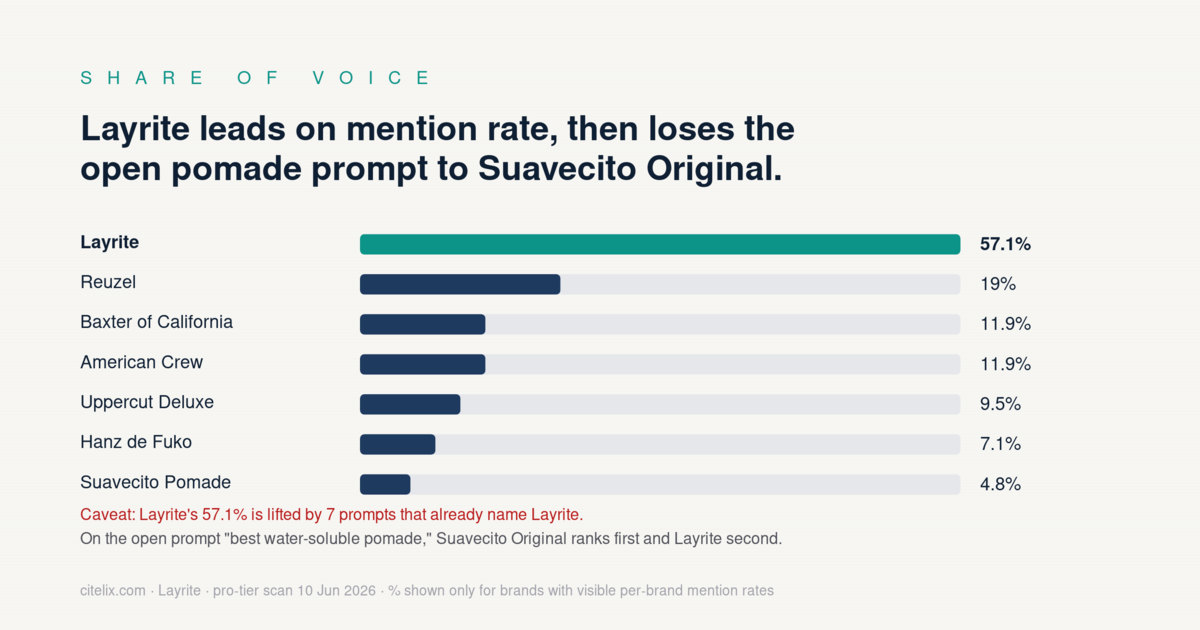
Read that with a caveat. Layrite’s 57.1% is lifted by the 7 prompts that already name Layrite, where it scores 100%. Strip those out and look only at open discovery prompts and the picture flips: Suavecito Original takes first on the open pomade prompt despite a 4.8% overall mention rate. Mention rate measures how often a brand appears. It does not measure whether the brand wins the moment that matters, which is the unbranded buying question.
One data note worth flagging: the dashboard’s share-of-voice legend lists Suavecito second while the competitor table shows Suavecito at a 4.8% mention rate, the lowest of the named set. I am reporting both numbers as shown rather than reconciling them. The takeaway does not change: Layrite is highly visible and still loses the open prompt.
What Layrite is missing
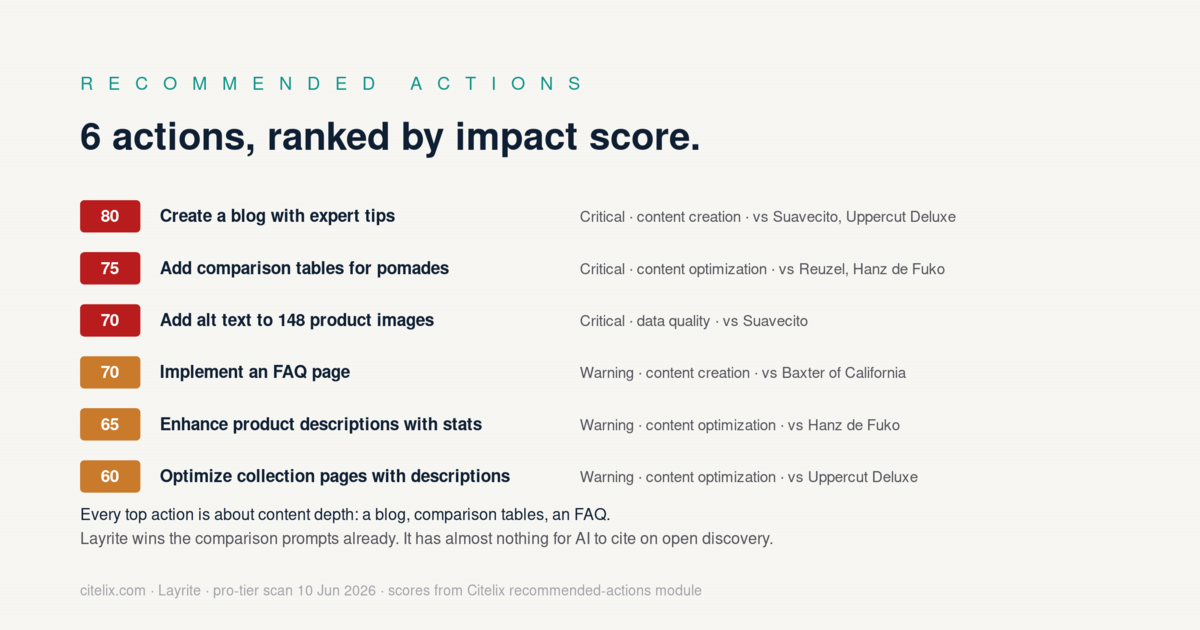
The Citelix scan surfaced 6 recommended actions. Every high-impact one points at the same root cause: Layrite has strong products and almost no surrounding content for AI to cite on open prompts. Specifically:
- No comparison tables on the pomade product pages, while Reuzel and Hanz de Fuko have them.
- No blog, while Suavecito and Uppercut Deluxe run content-rich ones.
- No FAQ page, while Baxter of California has one.
- 148 product images missing alt text.
- Collection pages with no descriptions.
3 fixes Layrite could ship this week
None of these require a new product or any ad spend.
Fix 1: Add a comparison table to every pomade product page
Why this matters: models quote structured comparisons verbatim. A table that states hold, shine, finish, and hair-type fit gives ChatGPT a clean block to cite on open prompts, not just branded ones.
How to do it: In Shopify admin, open each pomade product page (Deluxe Pomade, Cement Clay, Matte Cream, Original Pomade). Add a simple HTML table to the description: rows for hold level, shine, base (water-soluble), best hair type, and wash-out ease. Use plain language the model can lift. Start with the 4 hero SKUs.
Estimated time: 1 hour for the first four products.
Fix 2: Launch a styling blog with 5 cornerstone guides
Why this matters: the discovery winners all have blogs, and that is what models cite when a buyer asks an open “best pomade for X” question. Layrite’s heritage and barber credibility is the exact content AI is looking for, and right now it lives nowhere quotable.
How to do it: In Shopify admin, go to Online Store, then Blog Posts. Publish 5 guides that map to the open prompts in the scan: best water-soluble pomade for classic hairstyles, how to get a matte finish with Layrite Cement Clay, how to style a modern undercut, how to wash out pomade buildup, and Layrite vs the field on hold and shine. Write them to answer the question directly in the first paragraph.
Estimated time: 1 to 2 hours per post, shipped over the week.
Fix 3: Add a brand-positioning line and an FAQ block
Why this matters: models repeat the positioning a brand states clearly. “Barber-created water-soluble pomade since 1999” is a citable anchor. An FAQ block gives the model direct question-and-answer pairs to quote.
How to do it: Add the since-1999, barber-created line to the homepage hero and every product page intro. Then create an FAQ page in Online Store, then Pages, covering hold levels, water-soluble vs oil-based, which Layrite product for which finish, and how to wash it out. Keep answers to two or three sentences each.
Estimated time: 45 minutes.
The 30-second version
If you only do one thing: launch the blog and write the “best water-soluble pomade for classic hairstyles” guide first. That is the exact open prompt Layrite is losing to Suavecito, and a single strong, citable page is the fastest way to flip it.
Methodology
I ran this scan through Citelix on 2026-06-10 (pro-tier, 14 prompts across ChatGPT, Gemini, Perplexity, and Grok, with Claude collected via batch). Gemini returned a 429 billing error on every prompt and Claude was still processing at scan time, so the analysis uses the 42 responses from the three models that returned data. Mention rates and the discovery-gap split are computed only from that visible per-prompt data.
Prompt-drift note: this brand was queued under the prompt “Best men’s hair clay for thick hair.” The live scan bundled a broader set of 14 pomade and styling prompts and did not run that exact phrase. The closest matches were the matte-finish prompts, where Layrite Cement Clay was cited at position 1. The clearest discovery gap sat on the open water-soluble pomade prompt, so that is what this teardown anchors on. This teardown is independent and not sponsored by either brand.
Want this teardown for your store? Install Citelix on Shopify. We scan your store across ChatGPT, Gemini, Perplexity, Claude, and Grok every day and tell you exactly which prompts your competitors win and what to change.