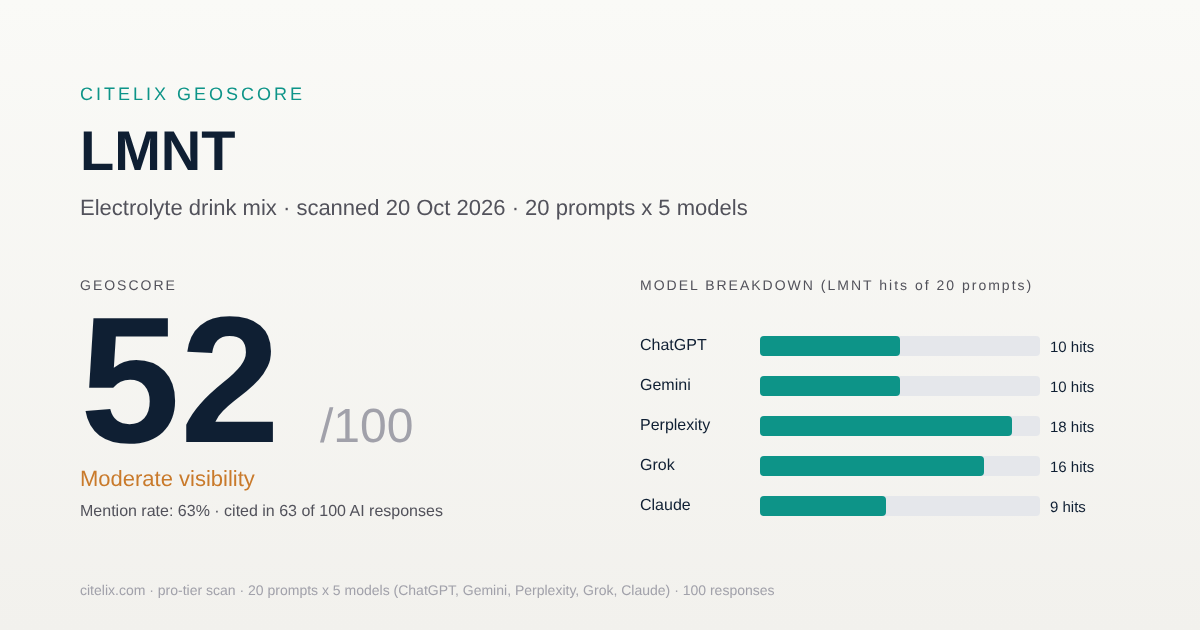
LMNT is the brand that made “more salt, not less” a category. So when I scanned it across ChatGPT, Gemini, Perplexity, Grok, and Claude this week, I expected strong numbers, and that is what came back: a Citelix GeoScore of 52 out of 100, cited in 63 of 100 AI responses, and position 1 on every single prompt that mentions LMNT by name.
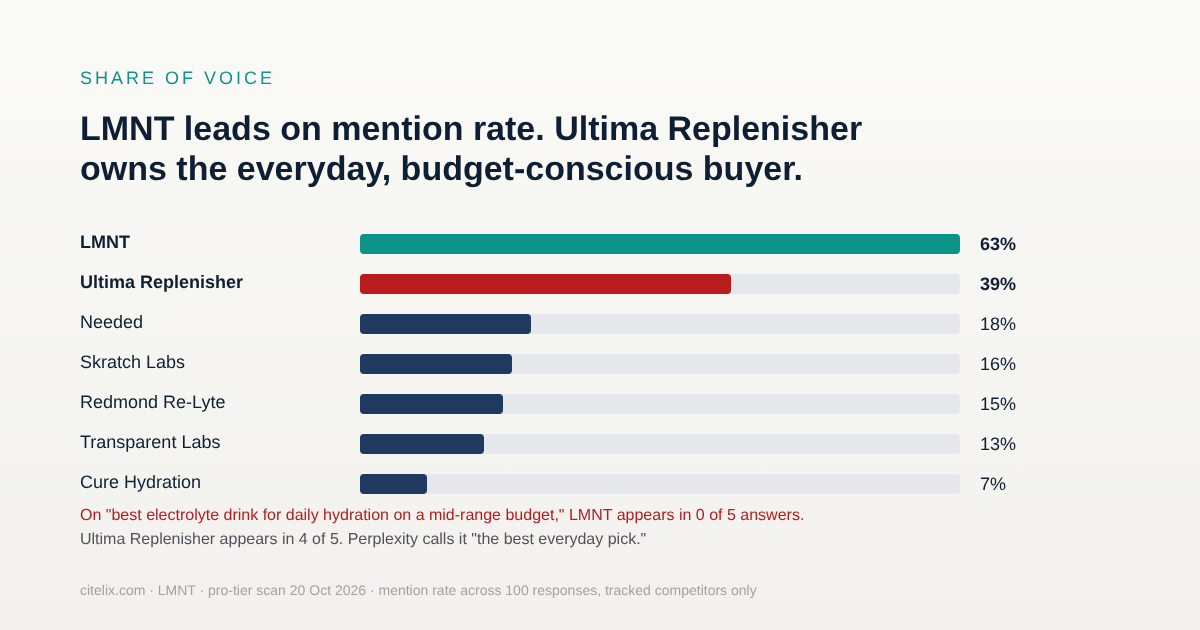
The weak spot is one specific kind of buyer. When someone asks for the best electrolyte drink for daily hydration on a mid-range budget, LMNT does not show up in any of the five models. Not lower in the list. Absent. Ultima Replenisher shows up in four of the five, and Perplexity calls it “the best everyday pick.”
The prompt I tested
The scan ran 20 hydration prompts. The one that matters most for this teardown:
“best electrolyte drink for daily hydration on a mid-range budget”
Why this prompt: “daily” means a repeat purchase, and “mid-range budget” means the buyer is about to compare price per serving. This is the subscription customer, the most valuable buyer in the category. LMNT already runs a subscription business. This is exactly the person it wants, and the models are sending that person somewhere else.
What the AI models said
Every model answered. None of them named LMNT.
- Perplexity led with Ultima Replenisher: “Ultima Replenisher is the best everyday pick,” framed around a price band of roughly $0.50 to $1.50 per serving, then Nuun, DripDrop, and Liquid I.V.
- Claude listed Nutricost, Ultima Replenisher (“Best for Daily Use,” quoting $0.48 to $1.05 per serving and 55 mg sodium), Transparent Labs Hydrate at $0.72 per serving, and Propel. It cited garagegymreviews.com.
- Grok listed Liquid I.V., Ultima Replenisher (about $0.33 to $0.40 per serving from a 90-serving tub), and Nuun.
- ChatGPT led with Nuun, Gatorade Zero, and Pedialyte, and also named Ultima Replenisher.
- Gemini went with Nuun, Liquid I.V., and Gatorade powder.
Now look at how the same models describe LMNT when it does come up. On “how to fix dehydration without sugar or artificial ingredients,” Perplexity listed LMNT first but called it “relatively high in sodium.” On the post-workout prompt it described LMNT Raw Unflavored as “very salty” and “for heavy sweaters.” The models have learned LMNT’s positioning perfectly. They just learned only half of it: LMNT is the salty one for athletes and keto, so it is not what you hand a casual daily drinker who is watching price.
The discovery gap
The pattern holds across the whole scan, not just one prompt.
- Brand-aware prompts (5 prompts that name LMNT, such as “LMNT vs Re-Lyte” or “are LMNT powders suitable for vegans”): LMNT cited in 25 of 25 responses, position 1 almost every time.
- Discovery prompts (15 prompts that do not name LMNT): LMNT cited in 38 of 75 responses, about 51%.
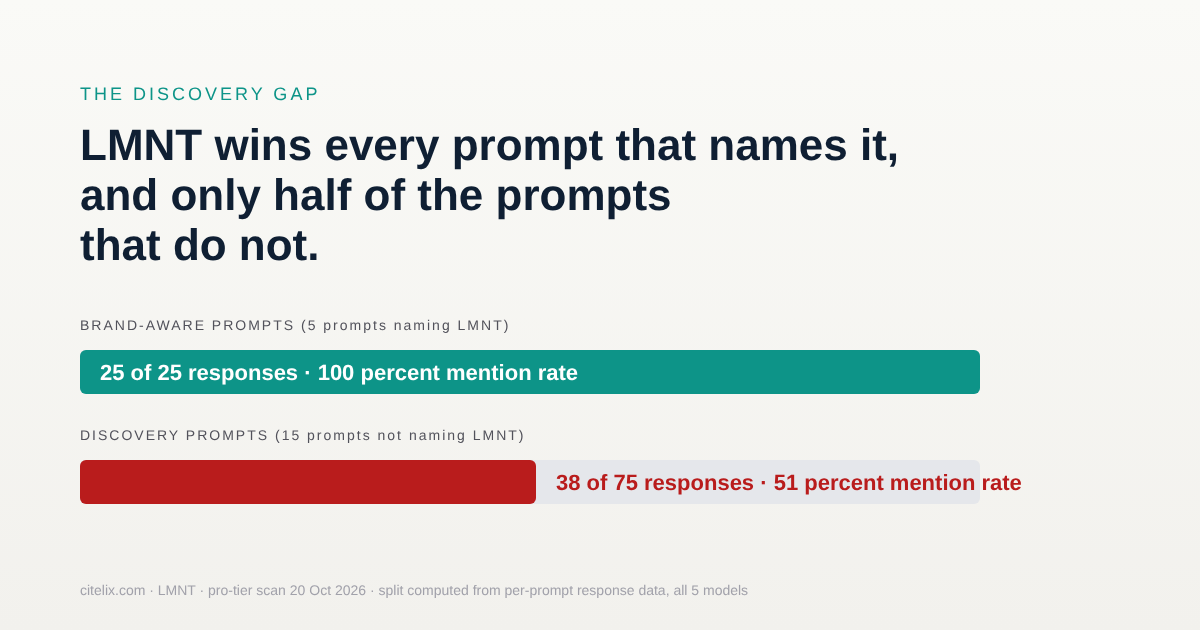
The split by model is just as telling. Perplexity cited LMNT on 18 of 20 prompts and Grok on 16. ChatGPT and Gemini stopped at 10 each, and Claude at 9. On ChatGPT, Gemini, and Claude, LMNT is roughly a coin flip once the buyer stops saying its name, and on those misses the models they fall back to the price-and-convenience brands: Nuun, Liquid I.V., Gatorade Zero, and Ultima.
Why Ultima Replenisher won this prompt
I read all five answers and the pages they leaned on. Four things put Ultima ahead on the everyday-budget question.
1. Ultima’s price per serving is easy to quote, and it is low
Every model that named Ultima quoted a per-serving price: $0.33 to $0.40, $0.48 to $1.05. LMNT’s own product page lists $45 for a 30-stick box, which is $1.50 per stick ($1.13 in the 120-count bundle). A model asked about a “mid-range budget” is doing arithmetic, and LMNT is at the top of the band it described.
2. Ultima owns “daily” in the review sites the models read
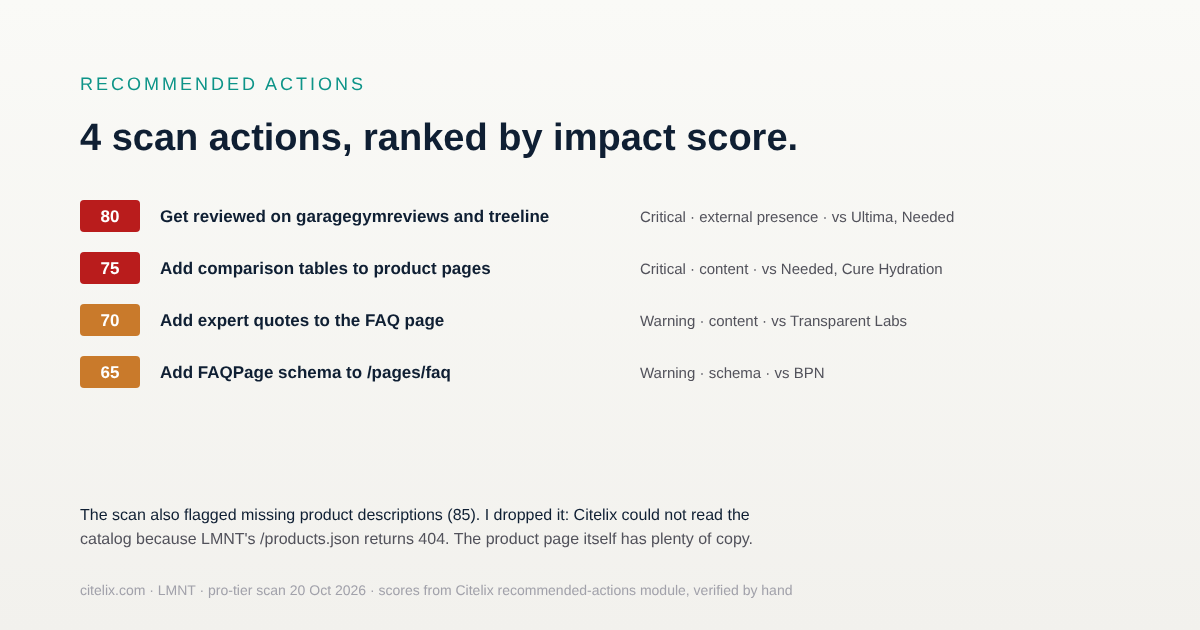
Claude’s budget answer cited garagegymreviews.com, which calls Ultima best for daily use. Across all 100 responses, the most-cited domains were garagegymreviews.com (10 citations), barbend.com (8), everydayhealth.com (8), treelinereview.com (7), and forbes.com (7). The Citelix scan flagged that competitors appear on garagegymreviews and treelinereview in roles LMNT does not hold. Third-party “best for” labels are what models repeat.
3. LMNT’s own copy reinforces the “salty, for athletes” frame
LMNT’s product schema describes the drink as “lots of salt and zero sugar.” Its FAQ answers “How much LMNT can I drink per day?” by saying it depends on the individual. That is honest, but it gives a model nothing to quote when a buyer asks “is this right for everyday drinking?” Meanwhile the answers about Ultima explicitly say “designed for everyday hydration” and “lower sodium.”
4. Ultima shows up in more open answers overall
Of the 10 tracked competitors, Ultima had the highest mention rate at 39%, more than double the next one (Needed, 18%). It appeared in ChatGPT’s answers on dehydration fixes, muscle cramps, post-workout hydration, and sugar-free hydration supplements, four prompts where ChatGPT did not mention LMNT at all.
What LMNT is missing
I checked LMNT’s site by hand. Here is what stands out for this prompt:
- No page answers the daily-drinker question. The FAQ at /pages/faq has 26 questions. None covers whether LMNT suits light, everyday hydration, what to do if 1,000 mg of sodium is more than you need, or how cost per serving compares.
- The Product schema names the wrong brand. On /products/lmnt-recharge-electrolyte-drink, the structured data lists the brand as “Elemental Labs,” not LMNT, with an empty image field and no review or rating data. Models and shopping agents that read schema get a weaker signal than the page itself gives a human.
- The FAQ page is not marked up as an FAQ. It carries WebPage and Organization schema, not FAQPage, so the 26 answers are harder for crawlers to lift as clean question-and-answer pairs.
- The science content lives on a separate subdomain. LMNT’s deep content is on science.drinklmnt.com and recipes.drinklmnt.com, while drinklmnt.com’s own sitemap lists 17 URLs. That is a reasonable setup, but it means the shop domain itself carries very little text about who LMNT is for.
3 fixes LMNT could ship this week
None of these need a new product or a price cut.
Fix 1: Publish a “Is LMNT right for everyday hydration?” answer
Why this matters: the models have only one story about LMNT (high sodium, heavy sweaters). Giving them a second, quotable story for the daily drinker is the most direct way into the budget prompt.
How to do it: Add an FAQ entry and a short page on drinklmnt.com that answers it directly in the first sentence. Cover the half-stick option for lighter days, how many sticks most people use per day, and the cost per serving at the 30-count, subscription, and 120-count bundle prices. State the $1.13 per stick bundle price plainly, since that is the number a budget-minded model should quote.
Estimated time: 1 to 2 hours.
Fix 2: Fix the Product schema
Why this matters: structured data is the cheapest signal to correct, and right now it tells machines the brand is “Elemental Labs.”
How to do it: In the theme’s product JSON-LD, set brand.name to “LMNT,” fill in the image array, add priceCurrency to each offer, and add an aggregateRating once reviews are exposed in the HTML. Then add FAQPage schema to /pages/faq. Test both in Google’s Rich Results Test.
Estimated time: 1 hour for a developer.
Fix 3: Pitch the “best for daily use” slot on the review sites models cite
Why this matters: garagegymreviews.com and treelinereview.com were among the most-cited sources in this scan, and they hand out the “best for X” labels models repeat word for word.
How to do it: Send samples and a one-page brief to the editors of their electrolyte roundups. Lead with the daily-use angle and the bundle price per serving, not the athlete angle LMNT already owns. Ask to be considered for a “best for daily use” or “best value” slot.
Estimated time: 1 hour to send, weeks to land.
The 30-second version
If you only do one thing: publish a plain answer to “is LMNT good for everyday hydration, and what does it cost per day?” LMNT already wins every prompt where buyers name it. The everyday, price-aware buyer is the one it is losing, and right now there is nothing on LMNT’s own site for a model to quote to that buyer.
Methodology
I ran this scan through Citelix on 2026-10-20 (pro-tier, 20 prompts across ChatGPT, Gemini, Perplexity, Grok, and Claude, 100 responses in total, Claude collected via batch). The GeoScore of 52 is the final score after the Claude responses landed. The brand-aware and discovery splits are computed from per-prompt response data. Competitor mention rates cover the 10 competitors the scan tracked. Prices and site details come from LMNT’s live product page and FAQ on the same day.
One data note: the scan’s top recommended action (adding product descriptions, score 85) was based on a crawl that found zero products, because LMNT’s /products.json endpoint returns a 404. LMNT’s product page actually carries plenty of copy, so I left that action out. This teardown is independent and not sponsored by either brand.
Want this teardown for your store? Install Citelix on Shopify. We scan your store across ChatGPT, Gemini, Perplexity, Claude, and Grok every day and tell you exactly which prompts your competitors win and what to change.