MUD\WTR’s homepage title is “Mushroom Coffee and Alternatives for Focus & Immune Support.” Its product page has a section headed “Immunity Support,” lists 2,240mg of mushrooms per serving, and cites a placebo-controlled cordyceps study. Immune support is half of the brand’s pitch.
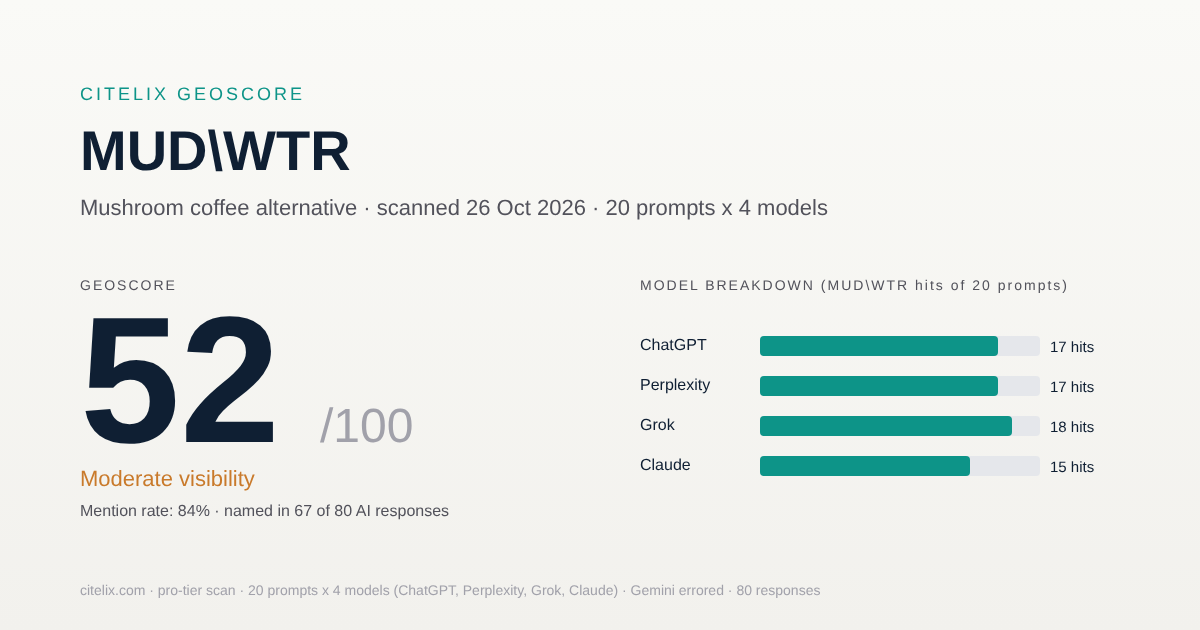
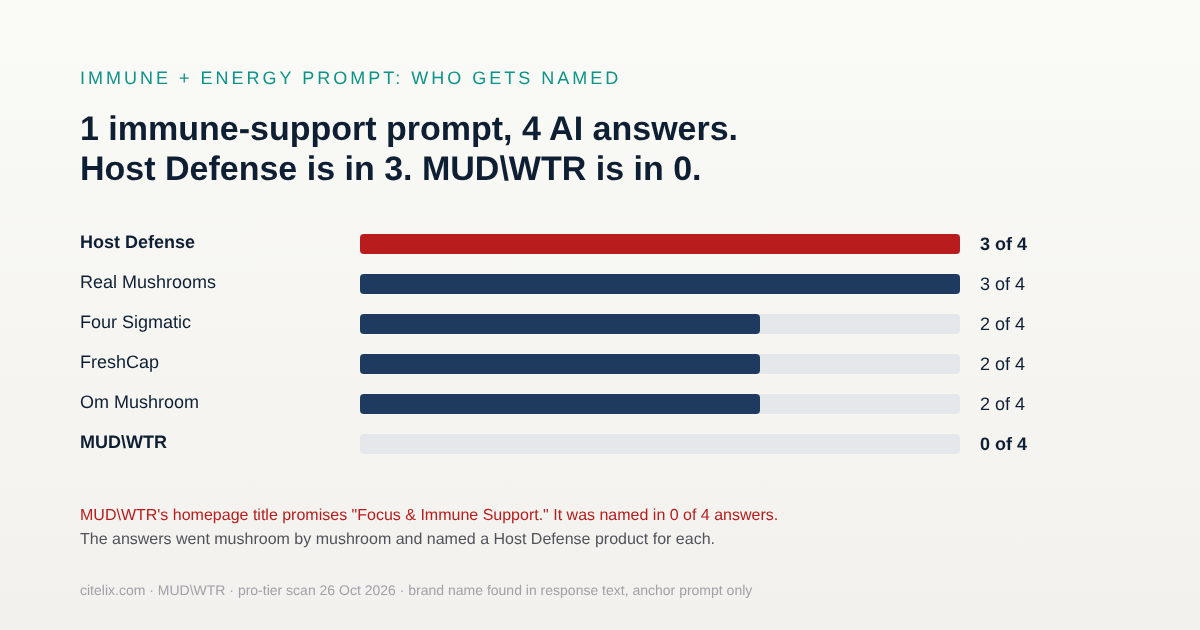
So when I scanned MUD\WTR across ChatGPT, Gemini, Perplexity, Grok, and Claude this week, I expected it to show up when a buyer asks about immune support. It mostly shows up everywhere else. The Citelix GeoScore came back at 52 out of 100, and MUD\WTR is named in 67 of 80 working AI answers. But on the one prompt about mushroom blends for immune support and energy, it was named in 0 of 4. Host Defense was named in 3.
The prompt I tested
The scan ran 20 mushroom-coffee prompts. The anchor for this teardown:
“which mushroom blend ingredients provide immune support alongside energy”
Why this prompt: it is the exact promise MUD\WTR makes on its own homepage, asked by someone who has not picked a brand yet. This buyer is not comparing coffee alternatives. They want a mushroom product that does two jobs, and they are asking which ingredients and which brands do both. That should be MUD\WTR’s easiest win.
What ChatGPT said
ChatGPT went mushroom by mushroom and attached a brand to each one. None of them was MUD\WTR.
- Reishi: Host Defense Reishi, “known for high-quality extracts,” and a Four Sigmatic reishi mix.
- Cordyceps: Om Mushroom Superfood and Real Mushrooms.
- Chaga: a chaga powder from another brand and Sun Potion’s chaga extract.
- Lion’s mane: Host Defense Lion’s Mane, then Four Sigmatic’s lion’s mane coffee.
- Shiitake: a single-mushroom supplement from another brand.
The other models told the same story. Grok’s first example product was Host Defense Cordyceps, and its list of “immune + energy” blends opened with Four Sigmatic and Host Defense MyCommunity, which it described as 17 species. Perplexity led with FreshCap, then Real Mushrooms and Host Defense, and called turkey tail “one of the strongest choices when immune support is the main objective.” Claude named no brands at all and described the same ingredients.
MUD\WTR contains four of the mushrooms these answers discussed: chaga, reishi, lion’s mane, and cordyceps. It was still left out of every answer.
The discovery gap
The pattern holds across the whole scan, not just one prompt.
- Brand-aware prompts (15 prompts that name MUD\WTR, such as “MUD WTR vs Dirtea for smoother energy”): MUD\WTR named in 60 of 60 responses.
- Discovery prompts (5 prompts that do not name it): MUD\WTR named in 7 of 20 responses, 35%.
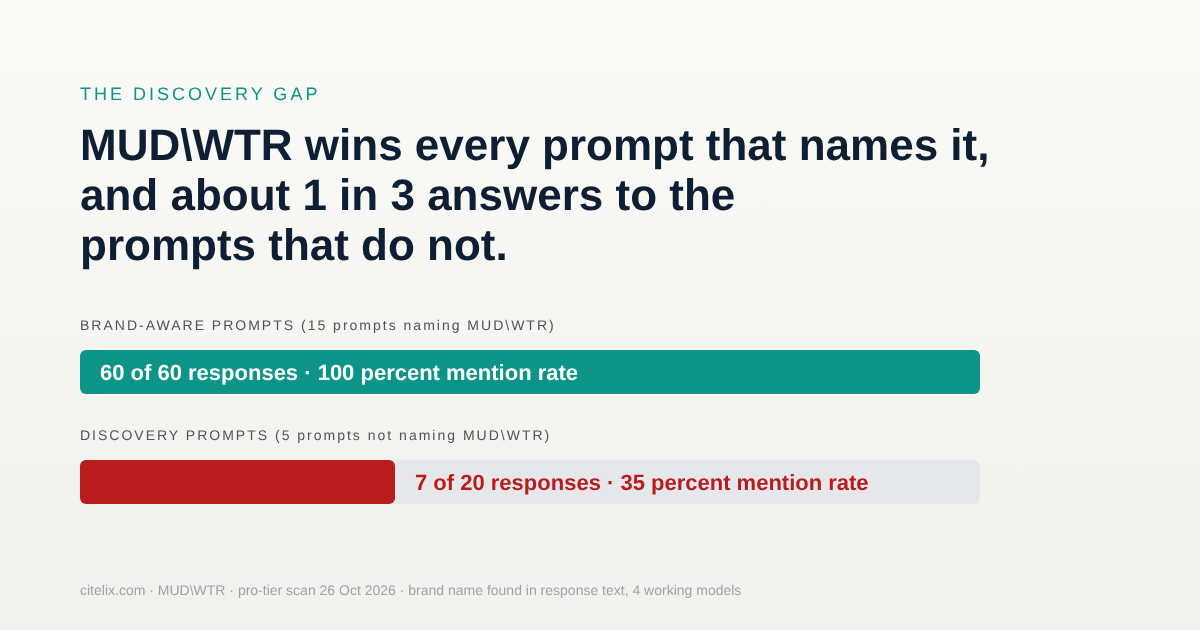
The two discovery prompts it does win are about the drink itself: “what to look for in a mushroom coffee substitute for caffeine sensitivity” and “what to consider when choosing a mushroom beverage powder for daily rituals,” where it was named in 3 of 4 answers to each. When the question moves from the ritual to the mushrooms, MUD\WTR drops out.
Why Host Defense won this prompt
I read all four answers and the sources behind them. Four things put Host Defense ahead.
1. Host Defense sells one product per mushroom, and the answer is organized by mushroom
Every model structured its answer as a list of species: reishi, cordyceps, chaga, lion’s mane, turkey tail. A model filling in “brand for reishi” and “brand for lion’s mane” reaches for a brand that sells a product with that exact name. The answers named Host Defense Reishi, Host Defense Lion’s Mane, and Host Defense Cordyceps-M as separate products. MUD\WTR sells blends named Original, Rest, Turmeric, and Matcha, so there is no slot for it to fill.
2. The immune answer runs on mushrooms MUD\WTR does not use
Perplexity and Claude both singled out turkey tail, maitake, and shiitake for immune support, describing them as rich in beta-glucans. MUD\WTR’s ingredient list is chaga, reishi, lion’s mane, and cordyceps. There is no turkey tail on the product page. Host Defense MyCommunity, the blend Grok named, covers many species at once.
3. MUD\WTR’s own content does not talk about individual mushrooms
MUD\WTR’s sitemap lists 335 blog articles. I checked every URL: none mentions immunity, chaga, reishi, cordyceps, lion’s mane, or turkey tail, and only 8 mention mushrooms or adaptogens at all. The models cited healthline.com, endoca.com, and several mushroom retailers for this prompt. No page on mudwtr.com was cited.
4. Four Sigmatic, its closest rival, is everywhere in MUD\WTR’s own scan
Across all 80 responses, Four Sigmatic was named in 26, more than any other competitor (Om Mushroom 14, Rasa 11, RYZE 10, Host Defense 8). On the immune prompt it appeared in 2 of 4 answers, both times right next to Host Defense. MUD\WTR is being squeezed from both sides: supplement brands own the ingredient story, and Four Sigmatic owns the coffee version of it.
What MUD\WTR is missing
I checked mudwtr.com by hand. Here is what stands out for this prompt:
- No per-mushroom pages. The product page lists the four mushrooms and the 2,240mg total, but there is no page explaining what chaga, reishi, lion’s mane, or cordyceps each do, how much of each is in a serving, or why MUD\WTR picked them.
- No beta-glucan number. The answers about immunity lean on beta-glucans. The product page does not state a beta-glucan content per serving. It says MUD\WTR uses “both the mycelial biomass and fruiting bodies,” and the ingredient list says the mycelium is cultured on organic oats, a detail buyers comparing extracts ask about.
- The immune claim is a label, not an answer. “Immunity Support” appears as a heading and “Supports immunity and gut health” as a line. The science section I read is built around cordyceps militaris: endurance, VO2max, and one paragraph on immune response. It does not tell a model which of the four mushrooms does what for immunity.
- Plenty of strong signals elsewhere. To be fair, the product schema is in good shape: the brand is set to MUD\WTR and it carries an aggregate rating of 4.4 from 116,246 ratings. There is a FAQ page and an on-page FAQ covering caffeine, taste, and the cordyceps species. The gap is topical, not technical.
3 fixes MUD\WTR could ship this week
None of these need a new product or a new formula.
Fix 1: Publish a “What each mushroom in MUD\WTR does” page
Why this matters: the models answer immune questions one mushroom at a time. If MUD\WTR has a clear, quotable paragraph for each of its four mushrooms, it can fill the reishi, chaga, cordyceps, and lion’s mane slots that Host Defense fills today.
How to do it: Create one page on mudwtr.com with a section per mushroom: what it is, what the research says about immune support and energy, the milligrams per serving, and which MUD\WTR blends contain it. Open each section with a one-sentence answer. Link it from the product page’s “Immunity Support” section and add FAQPage schema.
Estimated time: 3 to 4 hours.
Fix 2: State the beta-glucan content and extraction method on the product page
Why this matters: every immune answer in this scan mentioned beta-glucans or extraction quality. A specific number is the kind of fact models repeat when they compare brands.
How to do it: Add a short “What is in each serving” block: beta-glucan percentage or milligrams from the latest lab test, fruiting body versus mycelium split, and extraction method. If those numbers are not yet tested, test them, and publish the certificate of analysis.
Estimated time: 1 hour once the lab numbers are in hand.
Fix 3: Write two articles that compete with the ingredient answers
Why this matters: none of MUD\WTR’s 335 articles targets a mushroom by name. The models cited healthline.com and mushroom retailers instead.
How to do it: Start with “Best mushrooms for immune support and energy” and “Chaga vs reishi: which one is right for you.” Answer the question in the first paragraph, include a comparison table, and be honest about where MUD\WTR fits and where a single-mushroom supplement fits better. That honesty is what makes models comfortable citing a brand’s own page.
Estimated time: 1 day for both.
The 30-second version
If you only do one thing: publish a page that explains each of MUD\WTR’s four mushrooms on its own, with the dose per serving. MUD\WTR wins every prompt that names it and the prompts about the drink itself. It loses when the buyer asks about the mushrooms, because the models answer that question species by species and MUD\WTR has nothing on its site written that way.
Methodology
I ran this scan through Citelix on 2026-10-26 (pro-tier, 20 prompts across ChatGPT, Gemini, Perplexity, Grok, and Claude, Claude collected via batch and complete). All 20 Gemini calls came back empty, so this teardown uses the 80 responses from the other four models. The GeoScore of 52 is the scan’s final score on those responses. Every mention count comes from searching the full response text for “MUD\WTR,” “MUD WTR,” or “MUDWTR”; the scan’s own brand-mention flag caught fewer (a 57.5% mention rate versus 67 of 80 by text). Host Defense, Real Mushrooms, and FreshCap were not among the 10 competitors the scan tracked. Site details come from mudwtr.com’s product feed, sitemaps, FAQ page, and product pages on the same day.
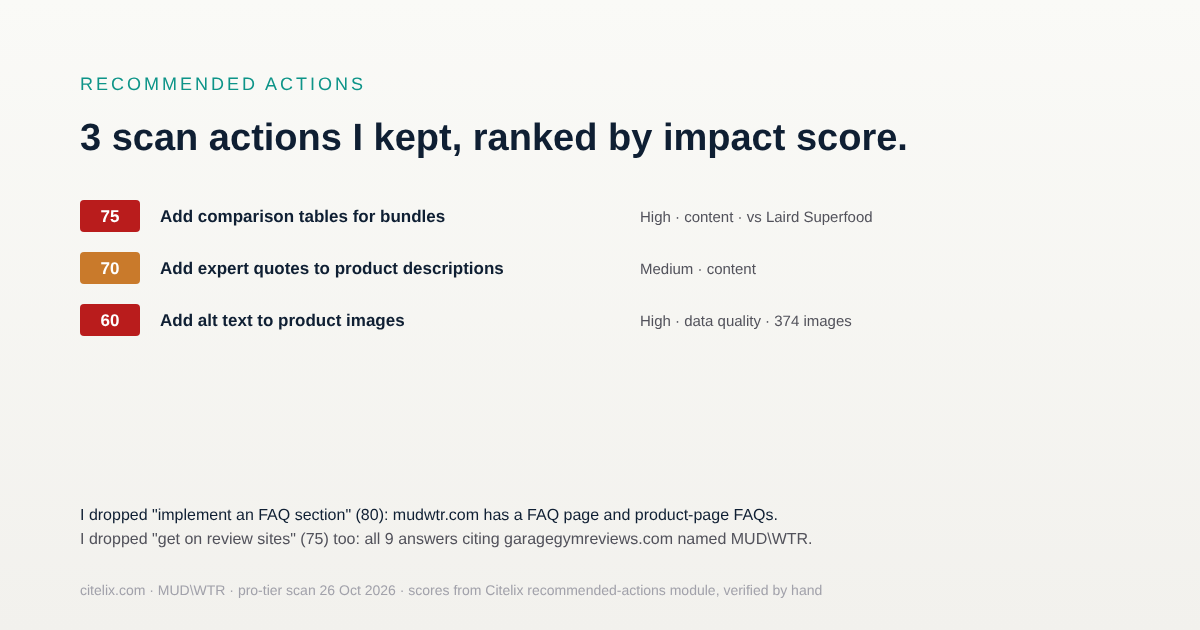
Data notes: the scan recommended “implement an FAQ section” (80), saying MUD\WTR has none. It has a FAQ page and an FAQ block on the product page, so I left that out. It also recommended “get reviewed on garagegymreviews.com and mudreview.com” (75), but all 9 answers that cited garagegymreviews.com and all 7 that cited mudreview.com named MUD\WTR, so I dropped that too, along with “add statistics to product pages” (65), since the product page already lists doses, caffeine, and a clinical study. This teardown is independent and not sponsored by either brand.
Want this teardown for your store? Install Citelix on Shopify. We scan your store across ChatGPT, Gemini, Perplexity, Claude, and Grok every day and tell you exactly which prompts your competitors win and what to change.