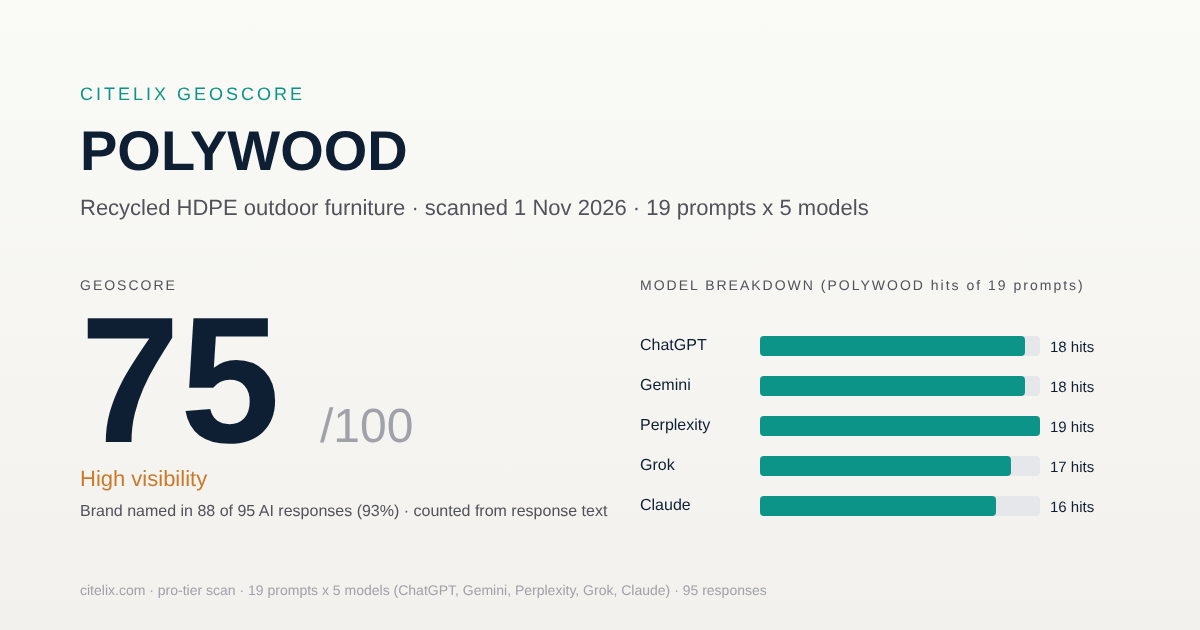
POLYWOOD is the strongest store I have scanned this week. Across ChatGPT, Gemini, Perplexity, Grok, and Claude, it is named in 88 of 95 responses, and its Citelix GeoScore is 75 out of 100.
So this teardown is about one model and one claim. POLYWOOD has been making furniture in the USA since 1990. When Claude is asked which brands make US-made recycled plastic seating, it names POLYWOOD last.
The prompt I tested
The scan ran 19 prompts. The anchor for this teardown:
“which outdoor furniture brands offer US-made recycled plastic seating”
Why this prompt: made in the USA and recycled plastic are the two claims in POLYWOOD’s homepage title and meta description. This is the prompt it should own.
What the AI models said
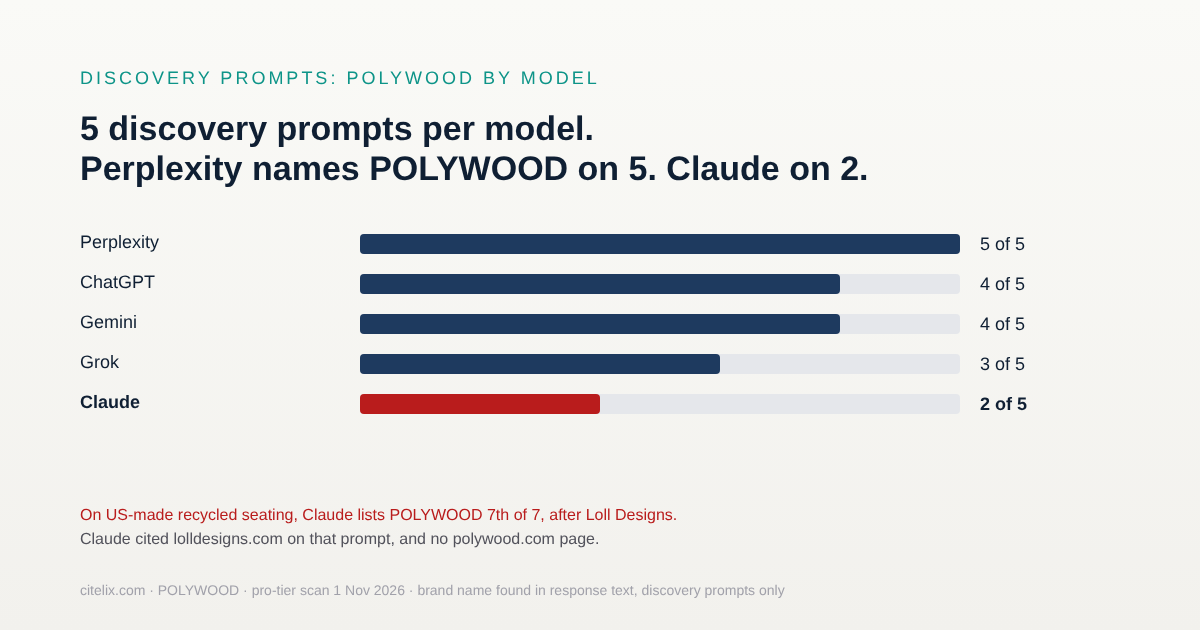
All five models named POLYWOOD. Three put it first. Claude did not.
- Claude listed seven brands: Loll Designs, Emeco, Berlin Gardens, Built to Last, Seaside Casual, Highwood, and then Polywood. Loll got the detail: “crafted in Duluth, Minnesota, by over 100 hardworking craftspeople,” with the milk-jug plastic it uses. POLYWOOD got one line: “Makes all-weather outdoor furniture from recycled materials headed for landfills and oceans.” No state, no factory, no number. Claude’s sources were sustainablejungle.com, lolldesigns.com, madeintheusamatters.com, and a kbpatiofurniture.com blog post. No polywood.com page.
- Gemini, Perplexity, and Grok all named POLYWOOD first. Perplexity and Grok named Loll Designs second.
- ChatGPT listed Trex Outdoor Furniture first and Polywood second. It did not mention that POLYWOOD makes Trex Outdoor Furniture. trexfurniture.com says its products “are manufactured and sold by POLYWOOD under a Trademark License Agreement with Trex Company, Inc.”
The discovery gap
There is barely one. On the 14 prompts that name POLYWOOD, the models name it in 70 of 70 answers. On the 5 that do not, they name it in 18 of 25.
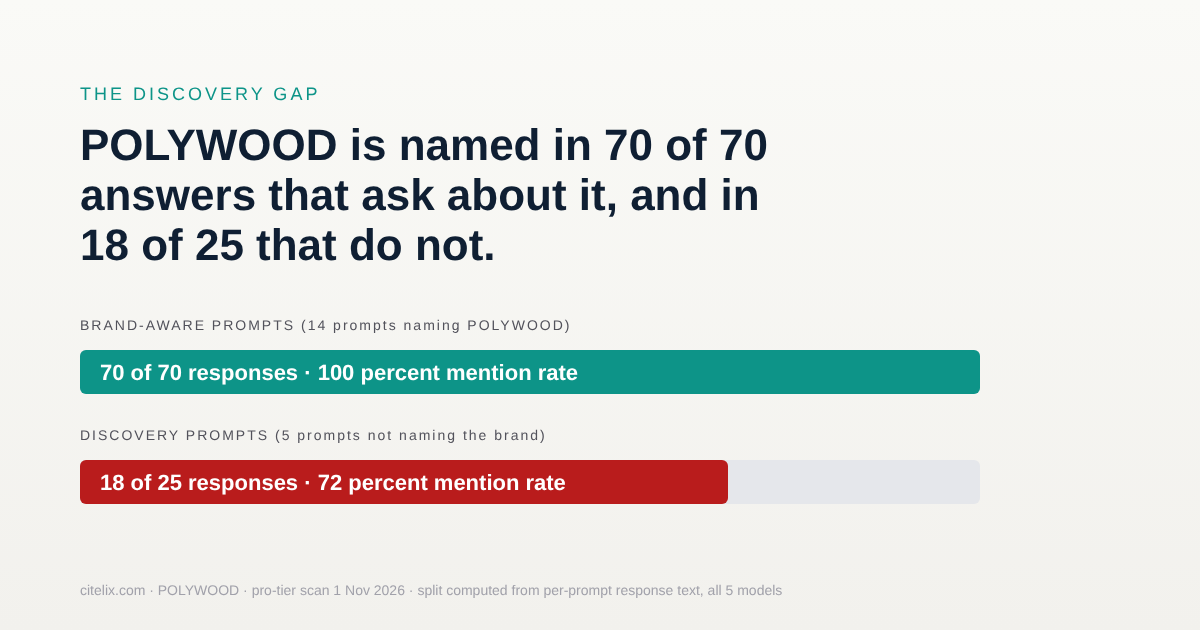
The gap is between models. Perplexity named POLYWOOD on all 5 discovery prompts. Claude named it on 2. Claude also skipped POLYWOOD on the poolside furniture prompt and the commercial-use concerns prompt, where it answered with general advice and no brands.
Why Loll Designs won on Claude
1. Loll’s homepage says the exact sentence Claude repeated
lolldesigns.com says: “We are proudly crafted in Duluth, Minnesota, by over 100 hardworking craftspeople, with parts and materials sourced in the USA.” Claude’s answer is nearly word for word. When a brand writes a specific, quotable sentence about where it makes things, the model can lift it.
2. POLYWOOD’s version of that sentence lives in fewer places
The POLYWOOD homepage does say “Made in the USA Since 1990” and that the company was founded in an Indiana garage, with facilities in Indiana and North Carolina. But the sustainability page says “Made in the USA” without naming a state. The FAQ has more than two dozen questions and none of them is “Where is POLYWOOD made?” On the Classic Adirondack Chair page, the only place Syracuse, Indiana and Roxboro, North Carolina appear is the shipping section.
3. Claude read the directories, not the brand site
Claude cited a sustainability roundup, a made-in-USA directory, and a patio retailer’s blog. Those are third-party lists, and Loll’s specific copy is what they repeat.
4. Trex splits the credit
Trex shows up in 13 of the 25 discovery answers in this scan. On this prompt, ChatGPT gave the top spot to Trex Outdoor Furniture, a line POLYWOOD itself manufactures. Some of the Trex mentions elsewhere are about Trex decking, not furniture. Either way, the name on the answer is not POLYWOOD.
What POLYWOOD is missing
I checked polywood.com by hand. This is a well-built store. The Classic Adirondack Chair page carries Product schema with a 4.7 rating from 459 reviews in the raw HTML, the product details render on the page, and the images have alt text. The store has 2,750 products in its feed and 242 articles in its sitemap. I opened three articles and all three load. Here is what is missing:
- A “Where is POLYWOOD made?” answer in the FAQ, with the cities.
- FAQPage schema. The FAQ at /pages/faqs has no FAQPage markup.
- The made-in-USA facts on product pages, in the product details, not only in shipping text.
- A comparison with Loll, Highwood, and Berlin Gardens, the US-made brands the models list next to POLYWOOD.
3 fixes POLYWOOD could ship this week
Fix 1: Write the sentence Claude can quote
Why this matters: Claude repeated Loll’s sentence almost word for word. POLYWOOD needs one of its own that is just as specific.
How to do it: Add one line to the sustainability page, the FAQ, and the product details block on every product: where the lumber and furniture are made (Syracuse, Indiana and Roxboro, North Carolina), since when, and what it is made from. Keep it factual and specific.
Estimated time: 1 to 2 hours.
Fix 2: Add “Where is POLYWOOD made?” to the FAQ, with schema
Why this matters: the FAQ already answers what HDPE is and how much of the lumber is recycled. It skips the question this prompt asks.
How to do it: Add the question with a two-sentence answer, and wrap the FAQ in FAQPage schema. Add one more: “Who makes Trex Outdoor Furniture?” The answer is on trexfurniture.com already.
Estimated time: 1 hour.
Fix 3: Get the specifics into the directories Claude cites
Why this matters: Claude’s answer came from made-in-USA directories and sustainability roundups, not from polywood.com.
How to do it: Contact madeintheusamatters.com and sustainablejungle.com and send them the same factual line from Fix 1, with a link to the sustainability page.
Estimated time: 1 hour to send, weeks to land.
The 30-second version
If you only do one thing: put one specific made-in-USA sentence, with the cities, on the FAQ and every product page. POLYWOOD is named in 88 of 95 AI answers. On Claude, for the claim POLYWOOD leads with, a smaller brand with a better sentence gets named first.
Methodology
I ran this scan through Citelix on 2026-11-01 (pro-tier, 19 prompts across ChatGPT, Gemini, Perplexity, Grok, and Claude, 95 responses in total, Claude collected via batch). The GeoScore of 75 is the scan’s final score after the Claude responses landed.
Brand counts come from whole-word matches in the response text and agree with the scan’s own count of 88. Positions come from the order of brand names in each response. Emeco, Built to Last, Seaside Casual, Highwood, and Trex were not in the scan’s tracked competitor list; I counted them from the response text.
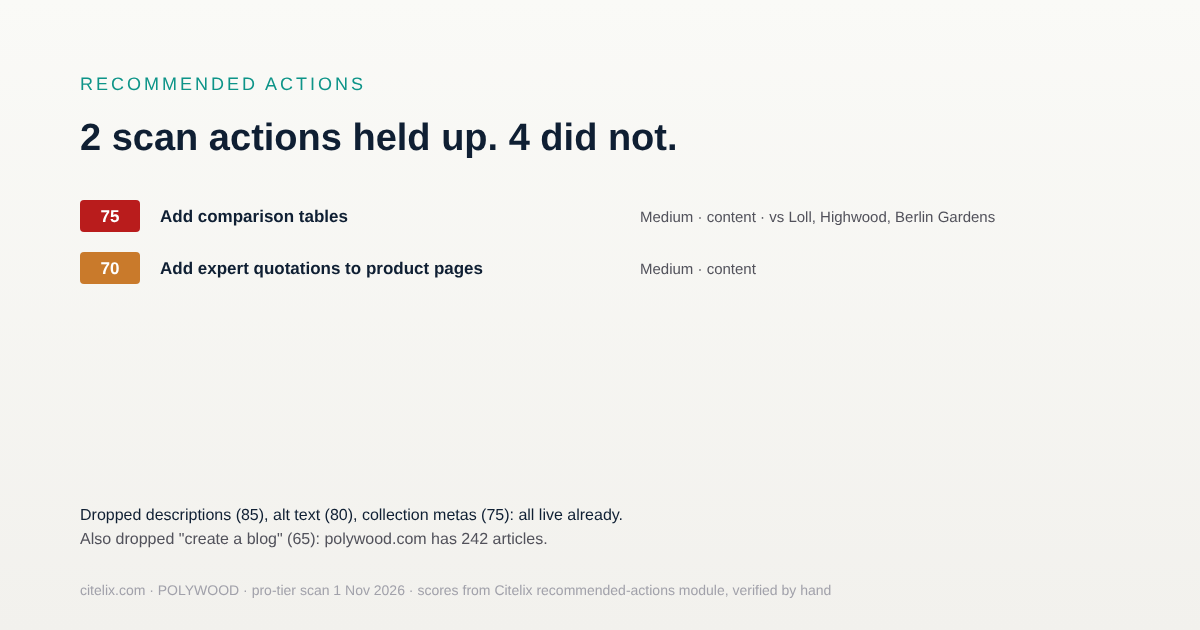
Four of the scan’s recommended actions were contradicted by the live site, so I dropped them. “Add Product Descriptions to All Products” (85) and “Implement Alt Text for Product Images” (80) were flagged because the product feed has empty descriptions and no image alt text, but the live product pages render product details and alt text. “Add Meta Descriptions to Collections” (75) is contradicted by the Adirondack Chairs and Outdoor Dining Sets collections, which both have meta descriptions. “Create a Blog” (65) is contradicted by 242 articles. Site details come from polywood.com and its sitemap, checked on 2026-11-01. The Loll Designs quote is from lolldesigns.com and the licensing line is from trexfurniture.com, both checked the same day. This teardown is independent and not sponsored by any brand.
Want this teardown for your store? Install Citelix on Shopify. We scan your store across ChatGPT, Gemini, Perplexity, Claude, and Grok every day and tell you exactly which prompts your competitors win and what to change.