Ritual built its brand on one idea: show the science. Traceable ingredients, clinical studies, a whole “Science & Design” section. Its gut product, Synbiotic+, is built on LGG and BB-12, which Ritual’s own product page calls “two of the world’s most clinically-studied strains.”
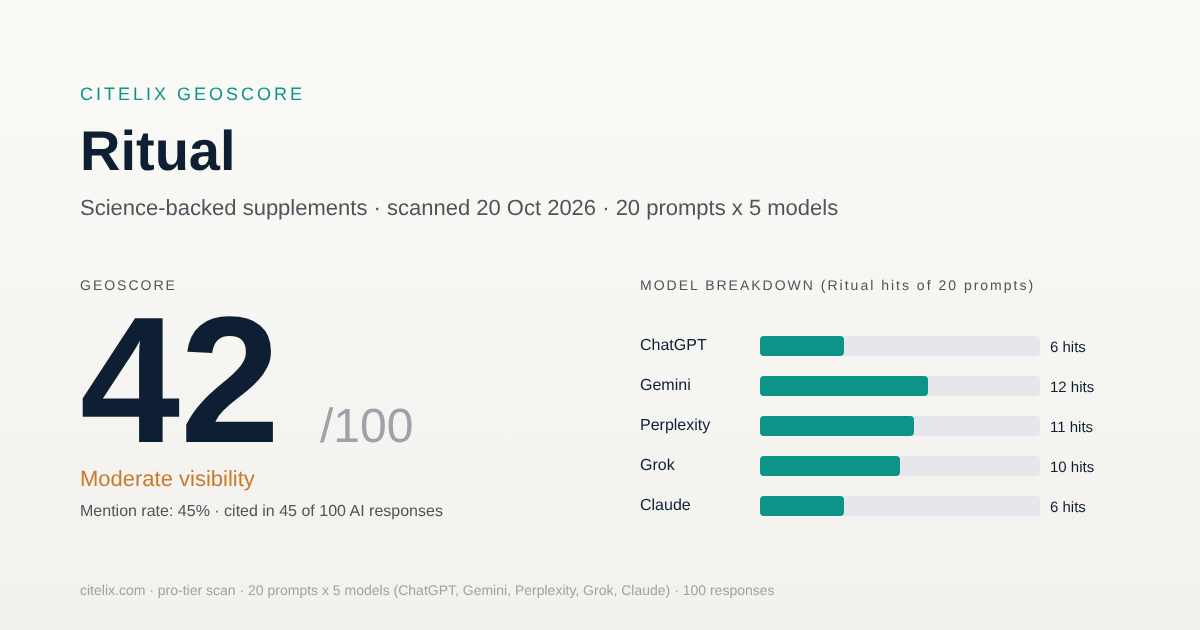
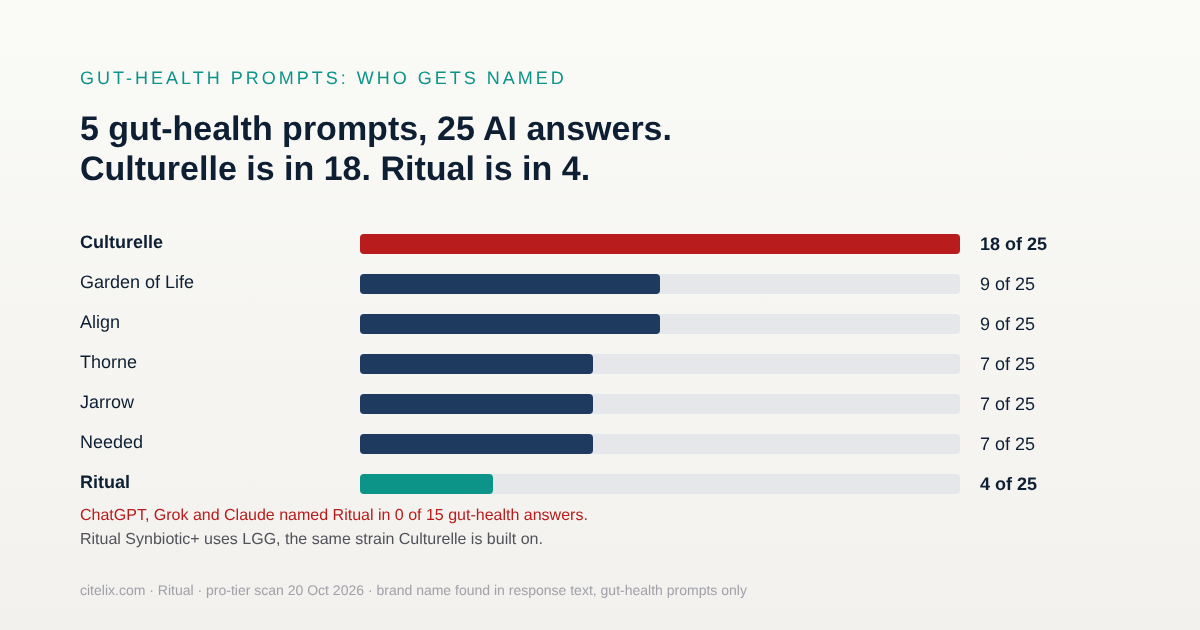
So I expected Ritual to do well on gut-health prompts when I scanned it across ChatGPT, Gemini, Perplexity, Grok, and Claude. It did not. Across 5 gut-health prompts and 25 AI answers, Ritual was named in 4. Culturelle, a drugstore probiotic built on that same LGG strain, was named in 18.
The prompt I tested
The scan ran 20 supplement prompts. The anchor for this teardown:
“top brands for gut health supplements with proven ingredients”
Why this prompt: “proven ingredients” is Ritual’s entire pitch, word for word. A buyer typing this has already decided they care about evidence, and they are asking for a brand. If Ritual cannot win this one, the science positioning is not reaching the models.
What ChatGPT said
ChatGPT did not mention Ritual. It led with Garden of Life’s Dr. Formulated Probiotics, then Culturelle, describing Culturelle this way:
This is a well-researched product featuring the strain Lactobacillus rhamnosus, known for its effectiveness in digestive health. It’s clinically proven and often recommended by doctors for overall gut health.
That is the exact strain inside Ritual Synbiotic+. ChatGPT gave the credit to the brand that has been saying “LGG” on drugstore shelves for years.
The other models split:
- Gemini put Ritual Synbiotic+ first, praising the 3-in-1 prebiotic, probiotic, and postbiotic formula and Ritual’s “commitment to ingredient transparency and traceability.” Culturelle came second.
- Perplexity listed Culturelle and Ritual Synbiotic+ as its first two picks, noting Synbiotic+ “uses clinically studied LGG and BB-12 strains” at about $54 a month, against Culturelle at about $18 a bottle.
- Grok went with Thorne FiberMend and Pendulum Akkermansia. No Ritual.
- Claude listed Now Foods, Thorne, Florastor, Megafood, Align, and Culturelle. No Ritual.
The gut-health gap
Widen the lens to all five gut-health prompts in the scan (“top brands for gut health supplements,” “top-rated supplements for improving gut health in adults,” “how to improve digestion naturally,” “chronic bloating and indigestion,” and “most effective for gut microbiome health”):
- Culturelle: named in 18 of 25 answers, including all 5 from ChatGPT and all 5 from Gemini.
- Ritual: named in 4 of 25. Three from Gemini, one from Perplexity.
- ChatGPT, Grok, and Claude: Ritual named in 0 of 15 gut-health answers.
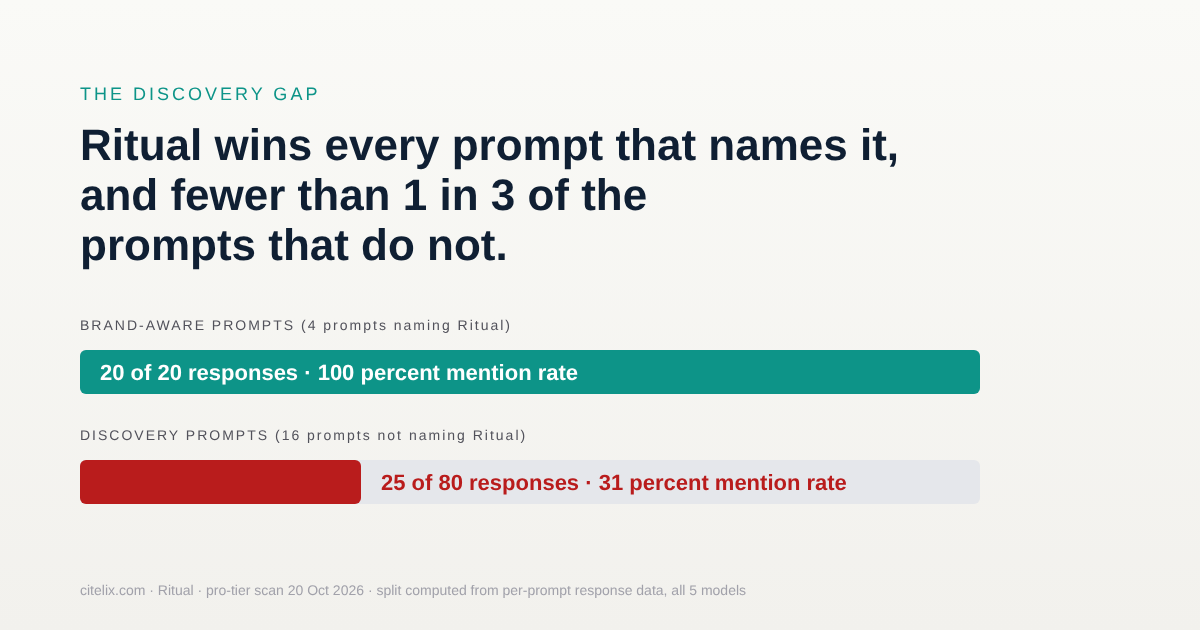
Zoom out to the full scan and the same shape appears. Ritual is cited in 20 of 20 responses to the 4 prompts that name Ritual, and in 25 of 80 responses to the 16 that do not. That is 31%. Its overall GeoScore is 42.
Why Culturelle won the gut-health prompts
I read all 25 gut-health answers and looked at the sources the models cited. Four things explain it.
1. Culturelle is the brand name attached to the strain
“Lactobacillus rhamnosus” or “rhamnosus” appears in 14 of the 25 gut-health answers. When a model reaches for “a well-studied strain,” Culturelle is the brand it has seen next to that strain most often. Ritual uses the same strain but sells it inside a 3-in-1 product called Synbiotic+, so the strain-to-brand link is weaker.
2. The models are reading roundups Culturelle is already in
The sources cited on the gut-health prompts were forbes.com/health’s best probiotics list, everydayhealth.com’s best gut health supplements, gnc.com’s gut health guide, Yahoo Health’s best probiotic roundup, vogue.com, and U.S. News’ OTC probiotic rankings. Drugstore staples like Culturelle, Align, and Florastor are standing entries on those lists. Across the whole scan, ritual.com itself was cited only 4 times, while healthline.com was cited 14 times.
3. Price shapes the “top-rated” answer
Perplexity priced Ritual at about $54 a month and Culturelle at about $18. Ritual’s own product data lists Synbiotic+ at $61.36. For an open “top-rated” or “best” question, cheaper, widely stocked products get a structural boost, because the roundups the models read reward value and availability.
4. Ritual’s best-probiotic article does not name a best probiotic
Ritual has the content. Its sitemap lists 361 articles across 6 blogs, including at least 12 on probiotics and gut health. But the article at /blogs/science/best-probiotic is titled “4 Things to Look for in a Probiotic.” It is a buying guide, not a recommendation, and it does not name a single competing product. A model looking for “the best probiotic” gets criteria from Ritual and names from everyone else.
What Ritual is missing
What I found on ritual.com, checked by hand:
- The Synbiotic+ page never puts the strains next to a comparison. /products/synbiotic-plus-for-gut-health names LGG and BB-12 and has 313 reviews, but has no comparison block. A buyer, or a model, never sees “same strain as Culturelle, plus a prebiotic and a postbiotic.”
- No review rating in the structured data. The page carries ProductGroup and Organization schema but no aggregateRating, so those 313 reviews are invisible to machines that read schema.
- The gut content is criteria, not answers. Articles like “best-probiotic,” “prebiotic-vs-probiotic,” and “signs-probiotics-are-working” explain how to choose, then stop short of naming anything.
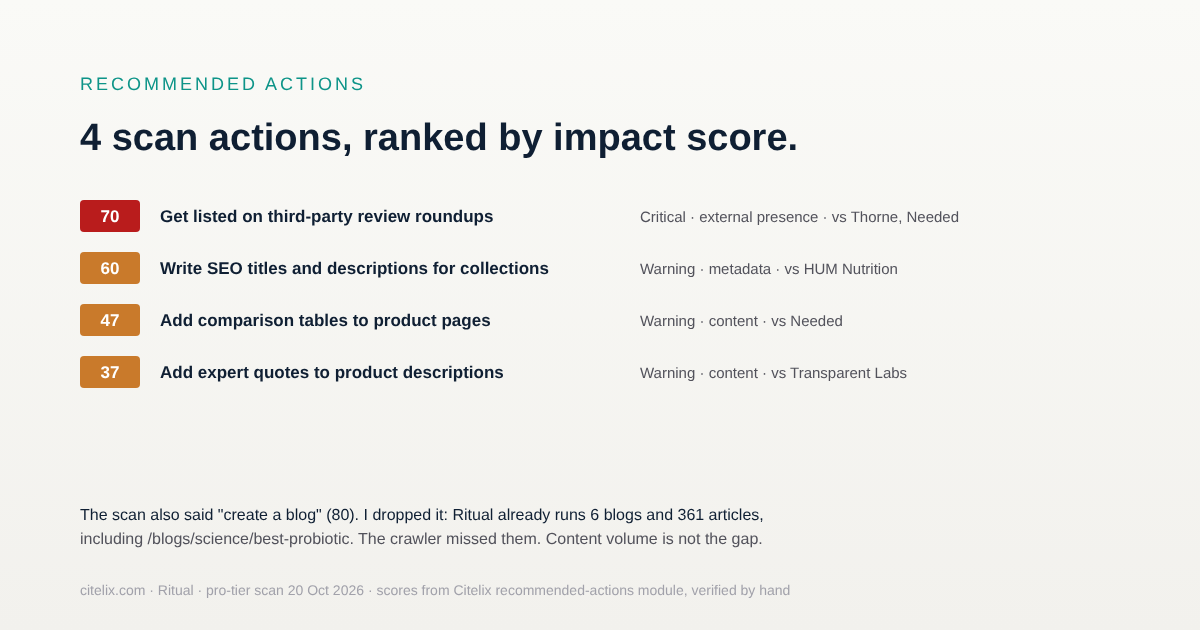
- Ritual is not in the roundups the models cite. The Citelix scan scored this its top usable action (70): competitors show up on third-party review sites and Ritual mostly does not.
3 fixes Ritual could ship this week
None of these need a new product or a lower price.
Fix 1: Rewrite /blogs/science/best-probiotic to actually answer the question
Why this matters: the URL already targets the exact phrase buyers type. Right now it hands the models a checklist and lets them fill in names from someone else’s list.
How to do it: Keep the four criteria, then add a section that applies them to real products: Synbiotic+, Culturelle Digestive Daily, Align, Seed DS-01, and a fiber option like psyllium. Show strains, CFU, prebiotic and postbiotic content, and cost per month in a table. Be fair about where cheaper single-strain products make sense. Models quote balanced comparisons far more readily than sales copy.
Estimated time: 3 to 4 hours.
Fix 2: Put a strain comparison block on the Synbiotic+ product page
Why this matters: Ritual’s strongest fact, that it uses the same clinically studied LGG strain as the category’s best-known probiotic plus BB-12, a prebiotic, and a postbiotic, does not appear anywhere a model can lift it in one sentence.
How to do it: Add a short table under the hero: “What’s inside vs a single-strain probiotic.” Rows for strains, prebiotic, postbiotic, delayed release, and third-party testing. Then add aggregateRating to the product’s JSON-LD so the 313 reviews count as a machine-readable signal.
Estimated time: 1 to 2 hours, including a developer for the schema.
Fix 3: Get Synbiotic+ into the gut-health roundups the models cite
Why this matters: forbes.com/health, everydayhealth.com, gnc.com, Yahoo Health, and U.S. News were the sources behind the gut-health answers. Getting into those lists is how a brand gets into the answers.
How to do it: Send samples and a one-page strain brief to the editors of each roundup. Lead with the LGG and BB-12 clinical backing and the 3-in-1 format. Ask to be considered for a “best synbiotic” or “best for bloating” slot rather than competing head-on for “best overall.”
Estimated time: 1 hour to send, weeks to land.
The 30-second version
If you only do one thing: turn /blogs/science/best-probiotic into a real comparison that names products, Synbiotic+ included. Ritual already has the strains, the studies, and the reviews. It is just not saying “here is the best probiotic and why” anywhere a model can quote it, so the models quote Culturelle instead.
Methodology
I ran this scan through Citelix on 2026-10-20 (pro-tier, 20 prompts across ChatGPT, Gemini, Perplexity, Grok, and Claude, 100 responses in total, Claude collected via batch). The brand-aware and discovery splits are computed from per-prompt response data. The gut-health counts come from searching the full text of the 25 responses to the 5 gut-health prompts for each brand name; Culturelle was not one of the 10 competitors the scan tracked, so it does not appear in the scan’s own share-of-voice table. Site details come from ritual.com’s live product page, product data, and sitemap on the same day.
One data note: the scan’s highest-scored action was “create a blog” (80). The Citelix crawler found zero blog posts, but Ritual’s sitemap lists 361 articles, so I left that action out. This teardown is independent and not sponsored by either brand.
Want this teardown for your store? Install Citelix on Shopify. We scan your store across ChatGPT, Gemini, Perplexity, Claude, and Grok every day and tell you exactly which prompts your competitors win and what to change.