Urban Remains sells antique American architectural artifacts from a warehouse in Chicago’s West Town and online at urbanremainschicago.com. Its sitemap lists more than 17,000 product URLs, and its About page says the site shows “well over 25,000 recovered artifacts.” Much of it is terra cotta, ironwork, and lighting salvaged from Chicago buildings, including pieces from Frank Lloyd Wright and Louis Sullivan designs.
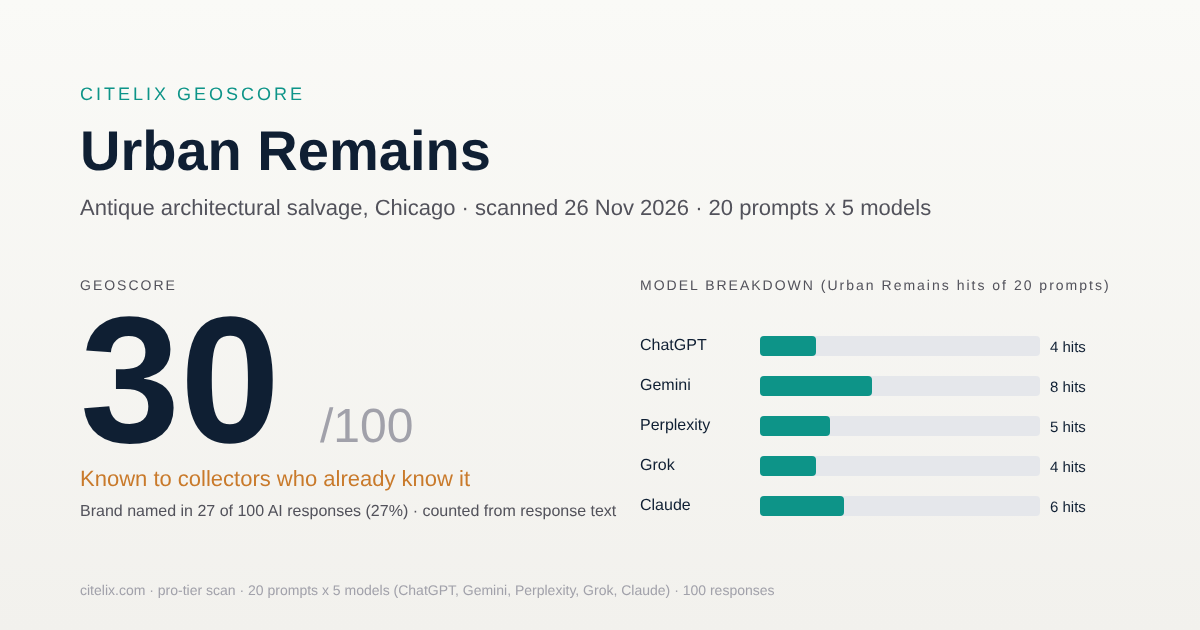
Across ChatGPT, Gemini, Perplexity, Grok, and Claude, Urban Remains is named in 27 of 100 responses. Its Citelix GeoScore is 30 out of 100.
The prompt I tested
The scan ran 20 prompts. The anchor for this teardown:
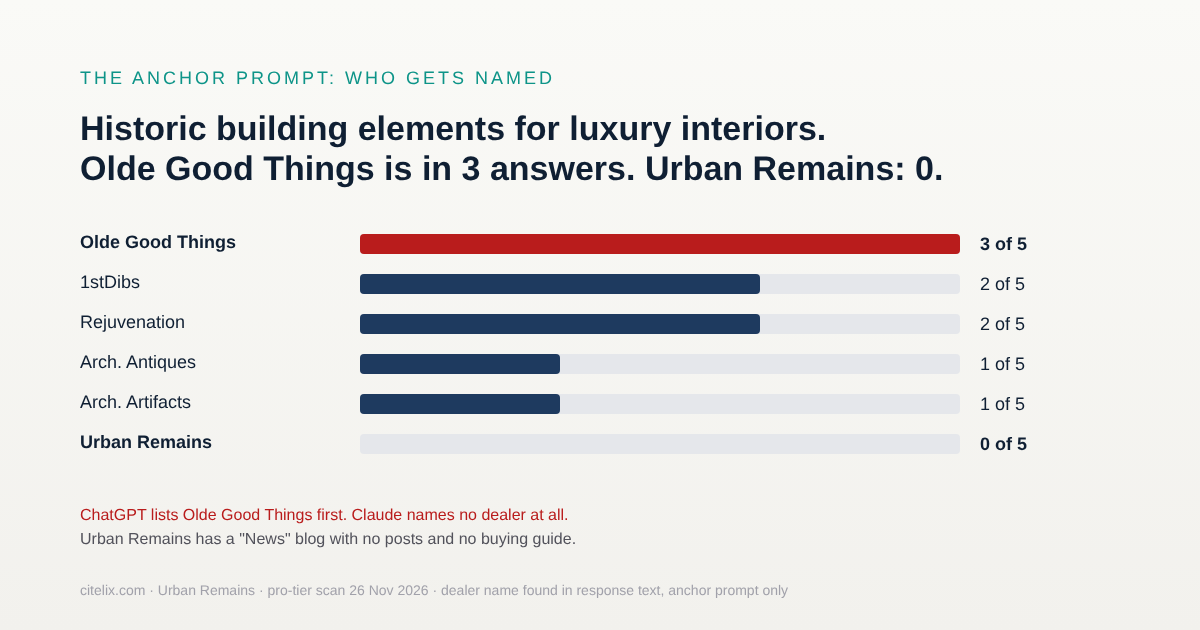
“best collectors guide to historic building elements suitable for luxury interiors”
Why this prompt: it is the designer and collector buyer Urban Remains is built for, asking where to start. It names no dealer, so the answer shows who the models think of first.
What the AI models said
No model named Urban Remains. Three named Olde Good Things.
- ChatGPT listed Olde Good Things as its first source, saying “They specialize in salvaged architectural elements, including cast-iron fixtures and wooden doors.” Then Rejuvenation, 1stDibs, and Etsy.
- Gemini named Architectural Antiques first, then Rejuvenation, Olde Good Things, and House of Antique Hardware, among others.
- Grok wrote a full guide, mentioned Christie’s and Sotheby’s sales, and in its list of specialist dealers said Olde Good Things has the “largest U.S. inventory of cast-iron elevator doors and terra-cotta tiles.”
- Perplexity named Irreplaceable Artifacts and Architectural Artifacts.
- Claude named no dealer at all. It recommended a book, Decorating with Architectural Salvage by Brian D. Coleman.
The discovery gap
Three prompts named Urban Remains, and all 15 of those answers named it back. Seventeen prompts did not, and Urban Remains is named in 12 of those 85 answers.
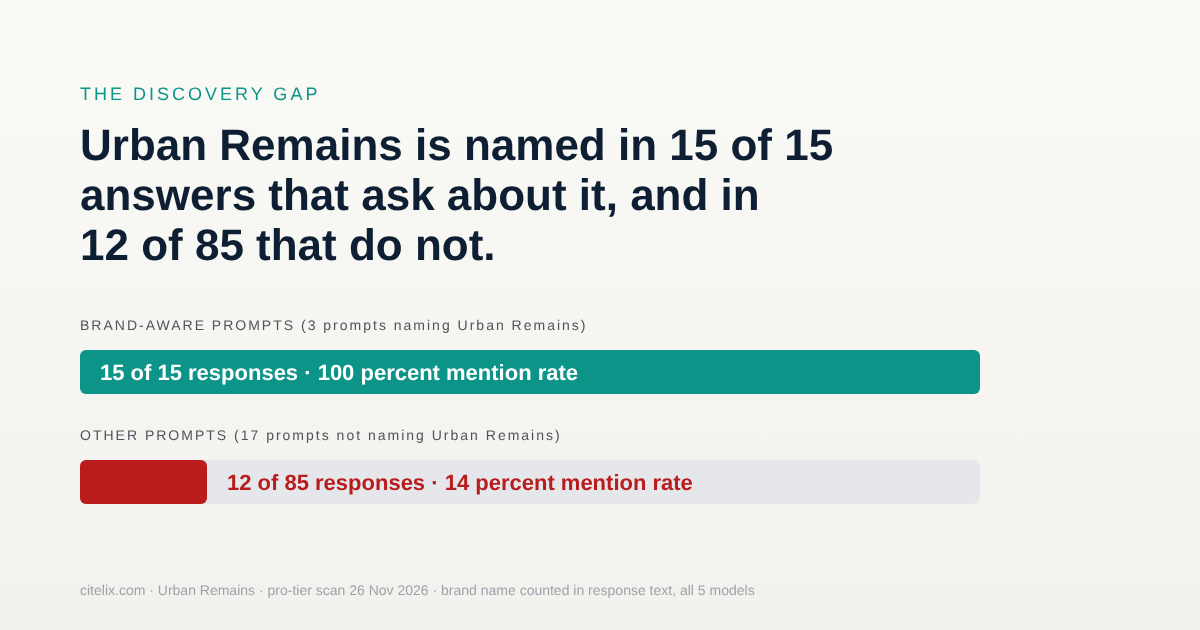
The 12 hits are telling. They came from prompts about very specific Chicago pieces: Sullivanesque terra cotta balusters, metalwork from demolished Chicago landmarks, a 1933-34 Chicago elevator backplate. When the question is about a Chicago artifact, the models know Urban Remains. When the question is about interiors in general, they do not.
Why Olde Good Things won
1. The models describe Olde Good Things by what it sells
Every model that named Olde Good Things said what you would find there: cast-iron fixtures, wooden doors, stained glass, tin ceilings, elevator doors. That is a category answer to a category question. The models describe Urban Remains by its Chicago provenance, which fits a collector hunting one piece, not a designer planning a room.
2. The sources were guides, and Urban Remains has none
Claude’s sources were articles: a guide on interior design with antiques, a dealer blog post on salvage and sustainable design, and posts on which salvaged materials matter most. Urban Remains has a blog called “News.” It has no posts. Its sitemap lists four pages: contact, about, clients, and a data opt-out.
3. The product pages are written for people who already know
4,720 of the first 4,750 product titles in the feed are all lowercase, and some have typos (“unuusal early 20th century white glazed terra cotta figual head”). 665 of those 4,750 descriptions are under 100 characters. One terra cotta panel reads, in full, “fritz albert for midland terra cotta company. priced individually.” The best pages are excellent: the Frank Lloyd Wright baluster page tells the story of the Robert Roloson row houses. But most pages give a model little to quote.
What Urban Remains is missing
I checked urbanremainschicago.com by hand. Product pages carry Product schema with Urban Remains as the brand and a meta description in the server HTML. Here is what is missing:
- Any guide content. The News blog is empty.
- A page for designers. Nothing says how a designer or architect should work with Urban Remains, what ships, or how pieces are installed.
- Readable titles. Lowercase titles with typos.
- An FAQ. /pages/faq returns 404.
3 fixes Urban Remains could ship this week
Fix 1: Publish “A collector’s guide to architectural salvage for interiors”
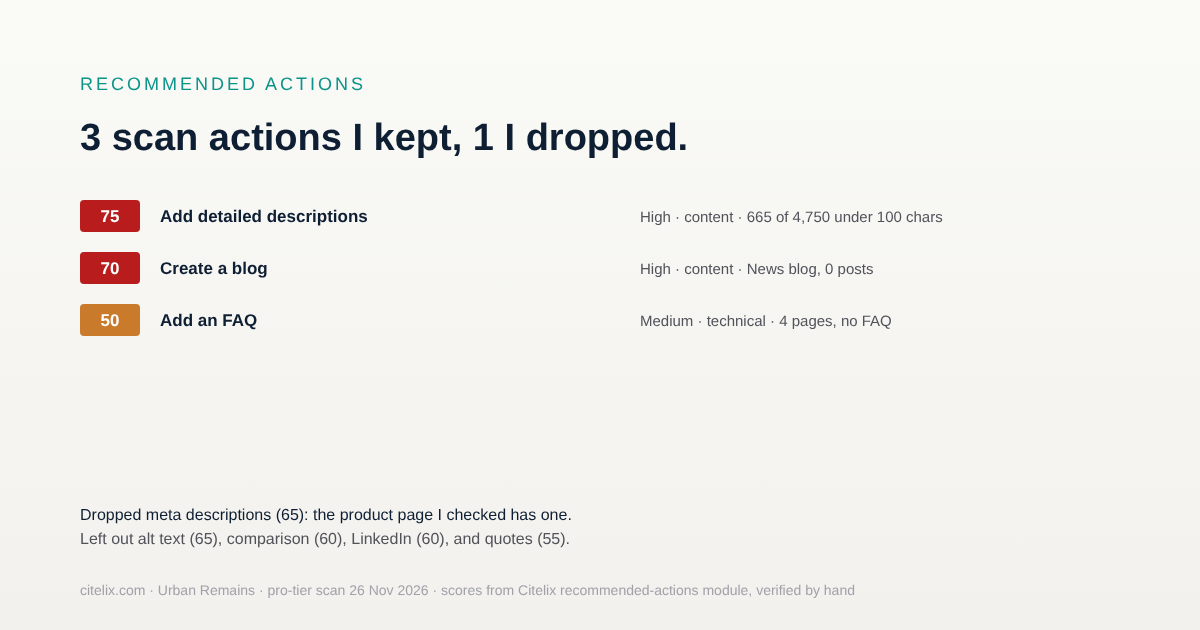
Why this matters: the scan’s blog action (70), and the exact shape of the anchor prompt. The answers were built from guides, and the News blog has none.
How to do it: One long article organized by element: terra cotta, cast iron grilles, lighting, elevator hardware, doors. For each, say what to look for, how it installs in a modern interior, and link the matching Urban Remains collection. Use the Chicago provenance as the proof, not the headline.
Estimated time: 4 to 6 hours.
Fix 2: Fix the titles on the top 200 in-stock pieces
Why this matters: the scan’s description action (75). Titles are what a model repeats. Lowercase titles with typos look like a scrape.
How to do it: Title case, fix spelling, and lead with the object: “Sullivanesque Terra Cotta Baluster, Frank Lloyd Wright Design, Roloson Row Houses (1894).” Add two sentences to descriptions under 100 characters: what it is, where it came from, size.
Estimated time: a day for 200 pieces.
Fix 3: Add a “For designers and architects” page with an FAQ
Why this matters: the scan’s FAQ action (50). The buyer in the prompt is a designer, and no page speaks to them.
How to do it: One page covering trade pricing, shipping crated pieces, condition and restoration, and how to request pieces by building or era. Mark the questions up as FAQPage schema.
Estimated time: 2 to 3 hours.
The 30-second version
If you only do one thing: write one guide to using architectural salvage in interiors. The models know Urban Remains for Chicago pieces. They need a reason to name it for a room.
Methodology
I ran this scan through Citelix on 2026-11-26 (pro-tier, 20 default prompts across ChatGPT, Gemini, Perplexity, Grok, and Claude, 100 responses in total, Claude collected via batch). The GeoScore of 30 is the scan’s final score. I counted “Urban Remains” myself with a whole-word match and found it in 27 of 100 responses. The scan’s mention flag found 22; I read the 5 extra snippets and all are real mentions, such as Gemini’s “Urban Remains has been dealing in reclaimed architectural artifacts for over 20 years.” Dealer counts on the anchor prompt are whole-word matches.
I kept three of the scan’s eight actions. I dropped “Add Meta Descriptions to All Pages” (65), because the product page I checked has one. I left out alt text (65), comparison tables (60), LinkedIn (60), and expert quotes (55). The product feed is capped, so title and description counts cover the first 4,750 products in it; the 17,000 figure is from the sitemap. I could not load Olde Good Things’ website from my location, so its description here is what the models said. Site facts are from urbanremainschicago.com on 2026-11-26. This teardown is independent and not sponsored by any business named.
Want this teardown for your store? Install Citelix on Shopify. We scan your store across ChatGPT, Gemini, Perplexity, Claude, and Grok every day and tell you exactly which prompts your competitors win and what to change.